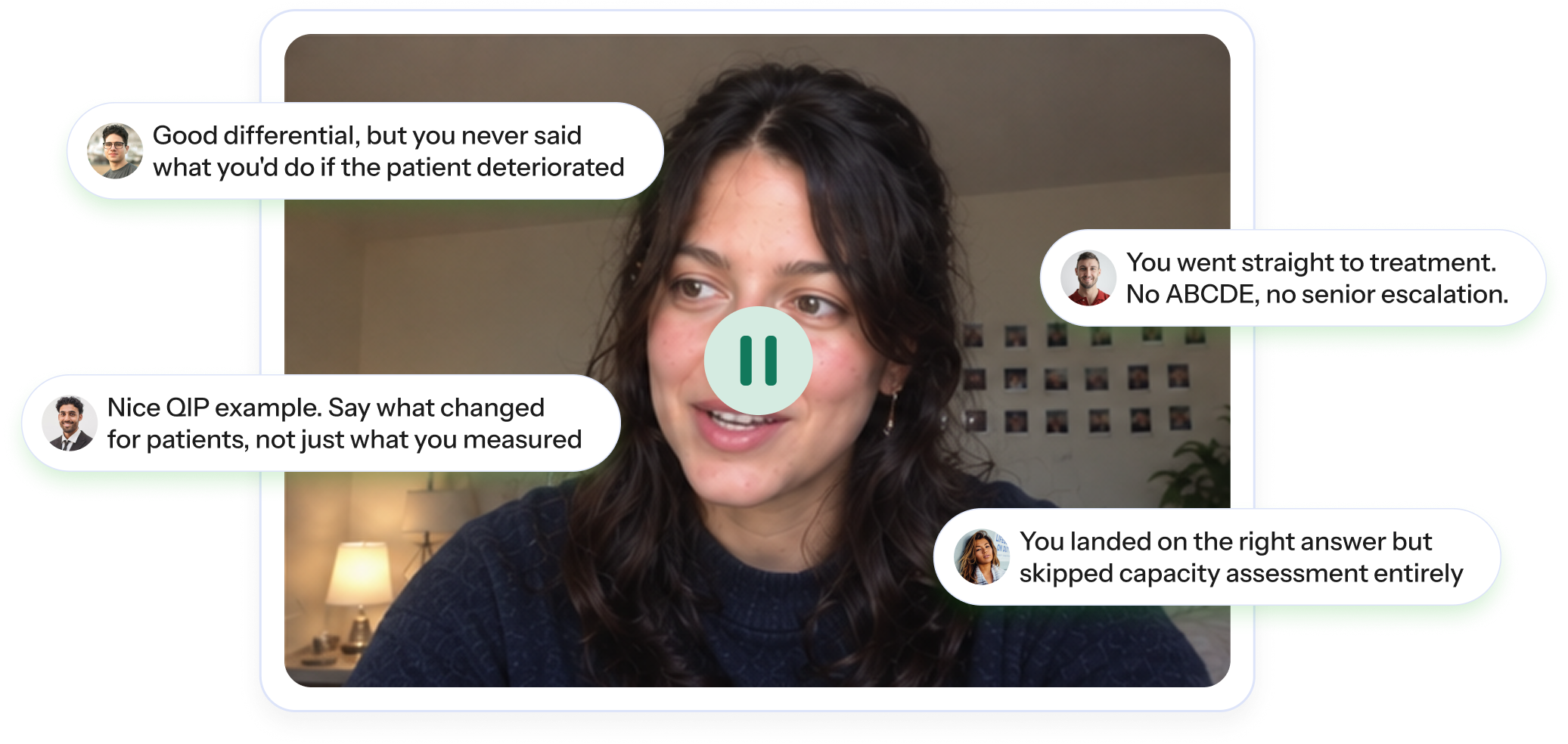
Endocrinology, Diabetes and GIM HST Interview Question Bank – Medibuddy Ireland
Endocrinology and Diabetes and GIM HST • 2027 Interview

The 2027 Endocrinology and Diabetes and GIM HST Interview Revision Platform: Question Bank, Live Practice and Mocks with Other Candidates

The Medibuddy Endocrinology and Diabetes and GIM HST Question Bank includes 65 scenarios and over 300 model-answered questions that closely mirror the real interview, each written and edited by high-scoring candidates who sat the Endocrinology and Diabetes and GIM HST interview in 2026.

However, knowing a strong answer isn't the same as delivering it well under pressure, which is why we provide:

10 years' experience preparing doctors for interviews

Users of the Medibuddy Endocrinology and Diabetes and GIM HST Revision Platform have secured some of the most competitive training posts in recent rounds. Ask around, there's a good chance the trainees in the year above you used us too.

Always up to date

Did you know the interviews change every year? That's why we review and update every Question Bank on the platform twice a year, so you know you're always practising with scenarios based on the latest interview structure.

Network and practise real interview scenarios with other candidates

Question Bank

See every scenario, and how to answer it well

65 scenarios across all four scored categories, which tell you exactly how to respond to each question.
Study Groups

Connect with candidates across the country
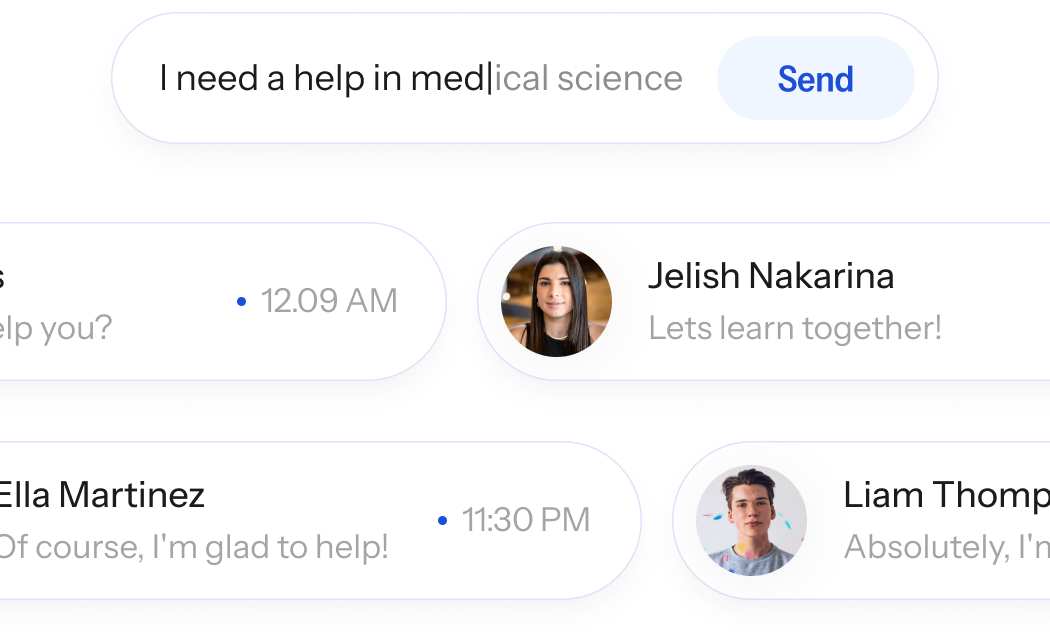
Most people only ever practise with one or two friends. Study Groups connect you with candidates right across the country sitting the same Endocrinology and Diabetes and GIM HST interview.
Live MocksBeta

Practise interview technique with different candidates
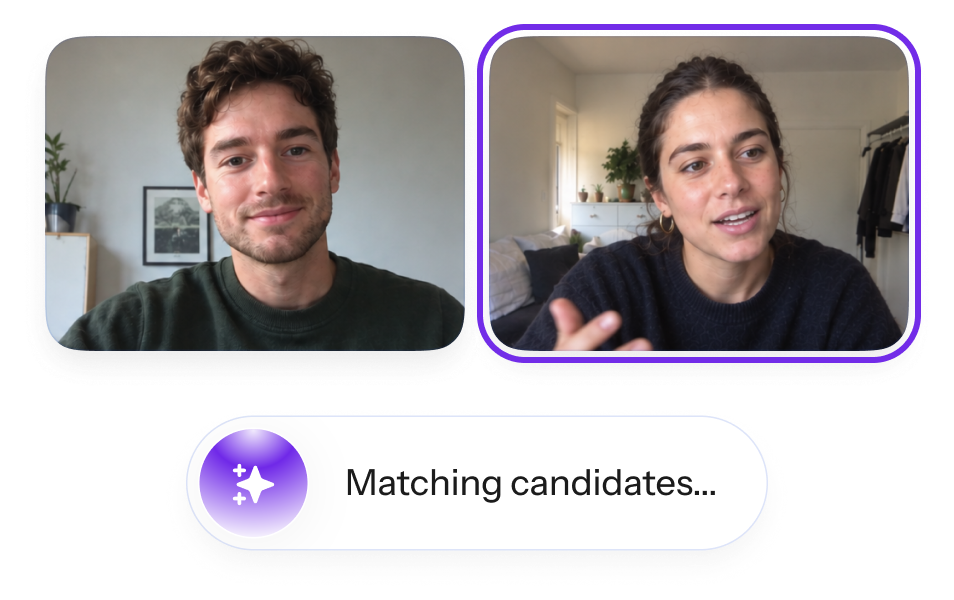
Arrange or get matched on demand with other candidates and run real scenarios out loud under interview conditions. Those who practise with the widest range of people tend to score the highest.
Peer FeedbackBeta

Reviewed by candidates across the platform
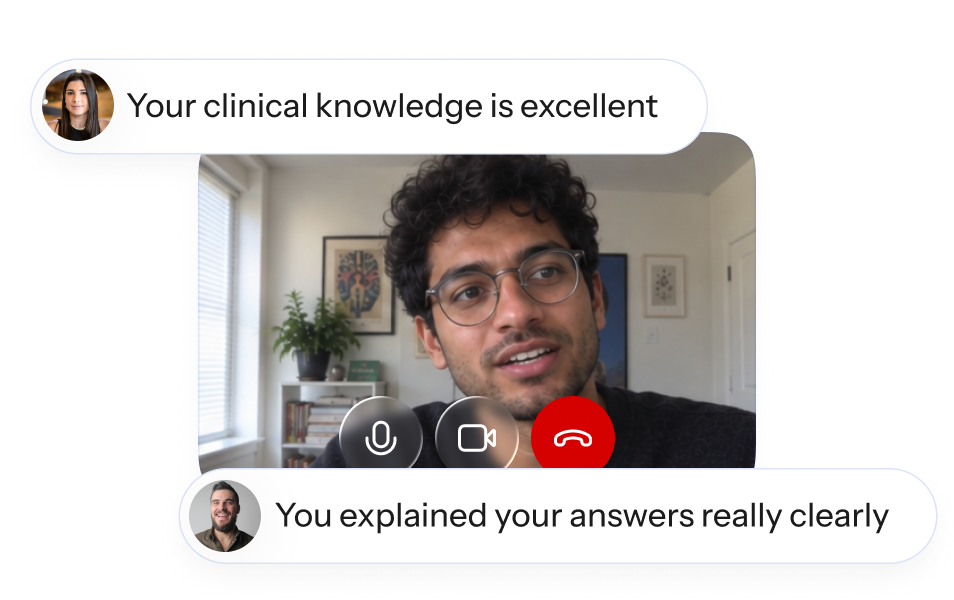
Submit your recorded mocks to candidates across the platform and get honest, varied feedback. Reviewing other people's mocks teaches you just as much.

The question bank, and other candidates to practise with, all in one platform.

Endocrinology and Diabetes and GIM HST Revision Platform • €170

Gain access to 65 scenarios across all four scored categories, and collaborate with other candidates through Study Groups, Live Mocks and Peer Feedback.
Get instant access
What candidates say

Scored well, secured their post

A few of the candidates who prepared with us for the Endocrinology and Diabetes and GIM HST interview.

Verified candidateInterviewed 2026
"Being ready across the CV, specialty knowledge and research questions as well as the acute diabetes and GIM scenarios meant nothing caught me off guard on the day."
Secured HST post
Verified candidateInterviewed 2026
"Practising the suitability and professionalism questions out loud with other candidates was the single most useful thing I did before the day."
Ranked highly
Part 1 • See the questions

The Medibuddy 2027 Endocrinology and Diabetes and GIM HST Question Bank

The interview is scored across four categories, each worth 25 marks, and each part is tightly timed, so you have a limited window to deliver the high-scoring answers you need to do well. That means every point has to land, and knowing how to structure each answer is essential. That's why each of our 65 scenarios comes with a model answer, written by candidates who scored highly in the 2026 Endocrinology and Diabetes and GIM HST interview, so you know exactly how to approach every question the panel puts to you.
What's inside

What's included in the Endocrinology and Diabetes and GIM HST Question Bank

There's nothing worse than reaching the interview and being handed a question you've never prepared for. The panel scores four categories, spanning your portfolio, your specialty knowledge and your clinical judgement, so the safest approach is to revise across all of them. We provide scenarios for every category, including the common themes and the trickier cases that have come up before, so you don't get caught out.

CV (Career to Date)

Questions on your training, achievements and career narrative, with model answers that show how to present your CV clearly and link it to what the panel is looking for.

Knowledge of the Specialty

Endocrinology and diabetes in depth, from inpatient insulin safety and DKA to thyroid, pituitary, obesity and bone, with structured answers and the acute GIM scenarios woven through.

Research, Audit & Teaching

Research, audit and teaching questions, with worked answers that show how to evidence your contribution and its impact.

Suitability, Professionalism & Interview Performance

Professional, ethical and communication scenarios, from capacity to breaking bad news and leading a busy take, with structured model answers.
Built around the four scored categories
Each category carries 25 marks. General internal medicine is assessed within the clinical scenarios and the questions on leading the medical take rather than scored separately. Every scenario is anchored to Irish practice, guidelines and law.
Try it

Try an example Endocrinology and Diabetes and GIM HST question

You are the first-year Specialist Registrar in Endocrinology and Diabetes Mellitus and GIM. A 22-year-old woman with type 1 diabetes since age 9 is referred from the Emergency Department with her third DKA in 14 months. She transferred from the paediatric diabetes service at 18 and attends adult clinic irregularly. Her last HbA1c was 91 mmol/mol. Blood ketones 4.2 mmol/L, venous pH 7.21, glucose 19.8 mmol/L, potassium 3.8 mmol/L. She is alert, heart rate 108, BP 104/68, respiratory rate 22.

How do you confirm this is DKA, and what are your immediate priorities?

Question
How do you confirm this is DKA and classify its severity, and what are your immediate priorities?
Example answer
She meets all three diagnostic criteria, so I start treatment while classifying severity.
  • Diagnosis: blood ketones 4.2 (at or above 3.0), glucose 19.8 (above 11.0), and venous pH 7.21 (below 7.3) with a low bicarbonate.
  • Severity: one marker is present, a heart rate above 100, while ketones under 6, a pH above 7.0 and a normal GCS and blood pressure are reassuring; I would discuss her with my consultant and ask for HDU review if she does not respond quickly.
  • Immediate priorities: two large-bore cannulae and cardiac monitoring, 0.9% sodium chloride and a fixed-rate insulin infusion at 0.1 units/kg/hour, a pregnancy test, urinalysis and blood cultures as infection is a common trigger, and I would inform my consultant about a third DKA episode.
Question
What investigations do you send, and what precipitants do you look for?
Example answer
I want the full metabolic picture and to find why she keeps presenting.
  • Bloods: laboratory glucose, full U and E with magnesium and phosphate, FBC and CRP (interpreting leucocytosis with care as ketosis alone raises it), blood cultures, HbA1c, thyroid function and coeliac serology.
  • Other: urinalysis and culture, chest X-ray, ECG and a pregnancy test.
  • Precipitants, explored sensitively: insulin omission including restriction for weight control, poor engagement or technology use, psychosocial stressors around the transition to adult services, infection, alcohol or substance use, and injection or pump failure.
Question
Describe your fluid, insulin and potassium management over the first six hours.
Example answer
I follow our DKA protocol, which is based on JBDS guidance.
  • Fluids: at around 60 kg with a systolic above 90, no bolus is needed; 1 L over 1 hour, 1 L over 2 hours, 1 L over 2 hours, then 1 L over 4 hours of 0.9% sodium chloride.
  • Insulin: a fixed-rate infusion at 0.1 units/kg/hour, continuing her basal insulin to prevent rebound ketosis, aiming for ketones to fall at least 0.5, bicarbonate to rise at least 3 and glucose to fall 3 per hour, troubleshooting or increasing the rate if targets are missed.
  • Potassium: at 3.8 it is in range, so add 40 mmol per litre and recheck hourly, involving my consultant if it falls below 3.5.
  • Glucose: once below 14, add 10% glucose alongside the saline without stopping the insulin.
Question
This is her third DKA in 14 months. What does this suggest, and how do you approach it once she has recovered?
Example answer
Three episodes in 14 months is a serious signal that needs structured assessment, not just discharge.
  • Causes to consider: deliberate or semi-deliberate insulin omission including restriction for weight, psychological comorbidity, alcohol or substance use, social instability, a failed transition from paediatric to adult services, or gaps in self-management skills.
  • Approach once recovered: a non-judgemental collaborative history covering all of these, specific questions about eating behaviours and feelings about her diabetes, involvement of the diabetes specialist nurse and psychology, a formal depression screen, and a review of whether she uses continuous glucose monitoring with support, in line with National Clinical Guideline No. 17 and access to DAFNE education.
Question
She discloses that she restricts her insulin to avoid weight gain. How do you manage this?
Example answer
Insulin restriction for weight control is a recognised, dangerous behaviour at the intersection of diabetes and an eating disorder, needing a specialist multidisciplinary response.
  • Acknowledge the disclosure without judgement, explore her fears around weight and food, and assess the frequency and risk of omission.
  • Multidisciplinary team: the diabetes specialist nurse for practical support, a clinical psychologist or liaison psychiatry for eating-disorder-focused care in the diabetes context, a dietitian with diabetes experience, and the consultant endocrinologist to agree gradually tightened targets, since rapid improvement can worsen retinopathy and cause insulin oedema.
  • Continuous glucose monitoring can help her see the consequences in real time and support safer control.
Question
She has not had a retinal screen or annual review for two years. How do you approach complications screening before discharge?
Example answer
Given her disengagement I would structure her overdue annual review opportunistically.
  • Screening: refer to Diabetic RetinaScreen for retinopathy, check an albumin-to-creatinine ratio and eGFR, examine her feet with referral to podiatry if abnormal, assess blood pressure and cardiovascular risk, and check thyroid and coeliac status.
  • Reproductive health: contraception, preconception counselling and folic acid advice given the risks of unplanned pregnancy with poor control.
  • Driving: discuss the RSA guidelines, as insulin-treated drivers must inform the NDLS and not drive with low or unaware hypoglycaemia.
  • Plan: complete as much as possible during admission and give her a written care plan and the diabetes nurse's contact details at discharge.

That's one scenario. There are 64 more.

Endocrinology and Diabetes and GIM HST Revision Platform • €170

Includes every scenario in the Question Bank, and access to Study Groups, Live Mocks with other candidates and Peer Feedback.
Get instant access
Actively maintained

How we keep our Question Banks up to date

The Endocrinology and Diabetes and GIM HST interview changes from year to year, and the biggest fear for any candidate is getting to interview day and realising you've revised with a question bank that's totally outdated.

That's why we review and update every Question Bank twice a year, so you know you're revising with scenarios that are likely to come up. We do this in April after the previous year's interviews, and again in the autumn when the new recruitment guidance is published.

For 2027, this process kept the Question Bank aligned with the current four-category format, across CV, specialty knowledge, research and teaching, and suitability and professionalism, so you always practise with the format the panel is using now.
Updated for 2027 Interviews
Part 2 • Practise them live

The only interview resource where you can practise live with other candidates from across the country

Our Endocrinology and Diabetes and GIM HST Question Bank tells you exactly how to answer real interview scenarios. But how you practise with them will determine how many marks you score. Simply reading answers off a screen won't prepare you for the intense scrutiny you'll face in the interview, and only practising with the same few colleagues limits the feedback you'll get. Medibuddy gives you unique access to Endocrinology and Diabetes and GIM HST candidates across the country, so you can learn from a variety of perspectives and hear a far wider range of feedback than your own circle could ever give you.
Study Groups
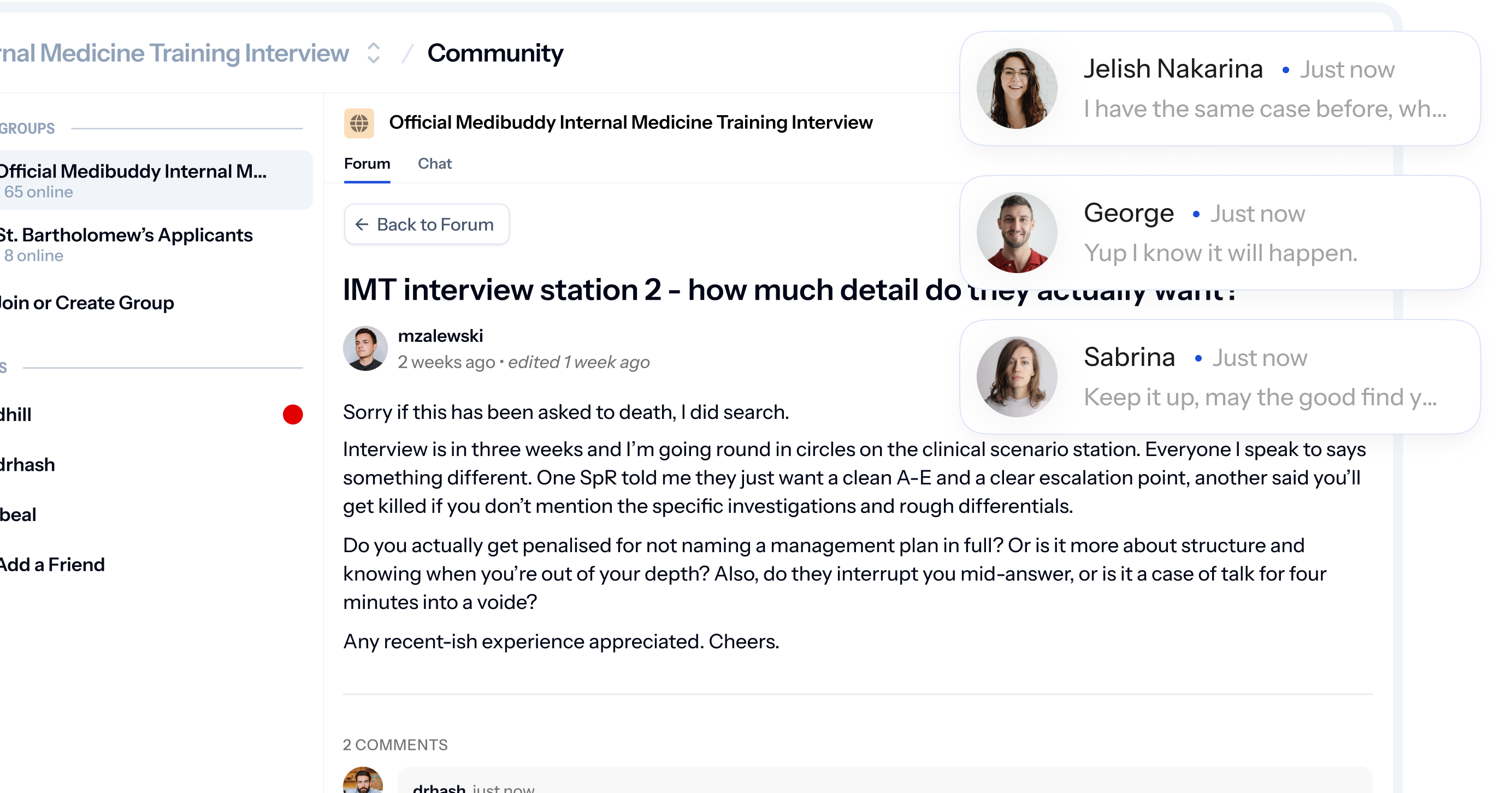
When you prepare in isolation, you're relying on your own interpretation of the interview process, which is one of the quickest ways to get found out on the day. Study Groups connect you with other doctors across the country who are also applying to Endocrinology and Diabetes and GIM HST, so you can engage and network with people preparing for the same interview as you. Everyone brings different experience from different units, meaning you won't miss out on the key bits of information that could swing the interview in your favour.
Live MocksBeta
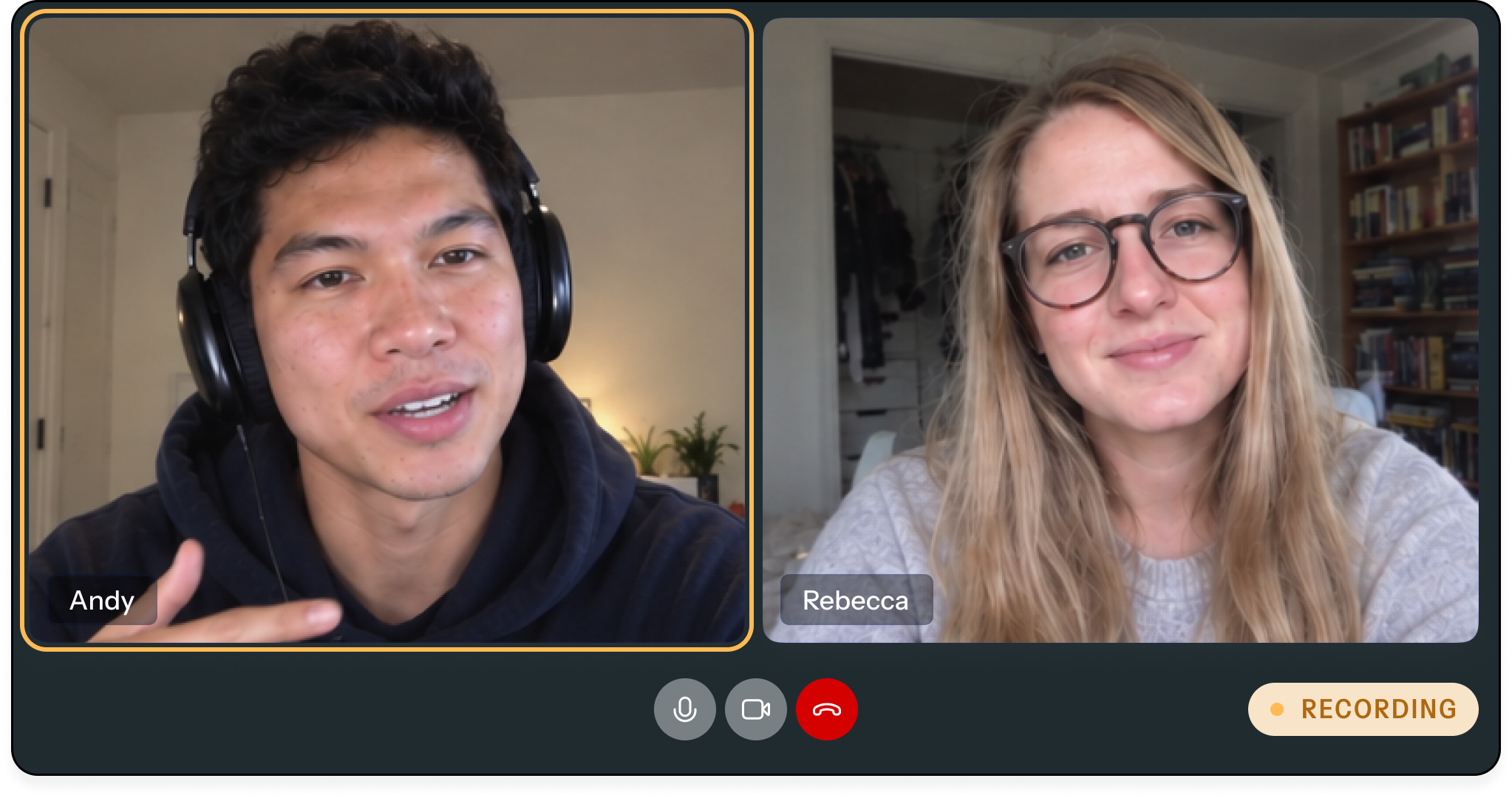
Candidates who don't take part in mocks often struggle to adapt to the pressure of the interview. Your knowledge might be correct, but without convincing delivery the interviewers will score you poorly. The best way to improve your delivery is to take part in as many live mocks as possible, which is why we haven't put a cap on how many you can do. All you have to do is join the waiting room and we'll match you with a different Endocrinology and Diabetes and GIM HST candidate each time. Take turns as both the interviewer and candidate on real Question Bank scenarios, so you can see exactly how other candidates perform in real time while refining your own technique.
Peer FeedbackBeta
Preparing alone means you won't know how you're coming across during the interview, and preparing with the same few candidates means you'll miss opportunities to improve, which is why it's so important to get as many opinions as possible on your performance. With Medibuddy, you can record a mock and submit it for feedback from other candidates on the platform, so you receive a wider range of feedback and refine your answers with each person you practise with. Reviewing other people's mocks is just as valuable, as it shows you how strong candidates handle the same scenarios.
The interview

What to expect from the Endocrinology and Diabetes and GIM HST interview

Higher Specialist Training in Endocrinology and Diabetes Mellitus and GIM is a dual programme run by the Royal College of Physicians of Ireland, and strong applicants are often separated by narrow margins at interview.

The interview is scored across four categories, each worth 25 marks: your CV and career to date, your knowledge of the specialty, research, audit and teaching, and suitability, professionalism and interview performance. General internal medicine is not scored separately in this dual programme; it is assessed within the clinical scenarios and the questions on leading the medical take.

Category

CV (Career to Date)

Your training, achievements and career narrative, and how you present them clearly and link them to what the panel is looking for.
Category

Knowledge of the Specialty

Endocrinology and diabetes in depth, with the acute GIM scenarios woven through, and your ability to discuss it with confidence and depth.
Category

Research, Audit and Teaching

Your research, audit and teaching experience, and how you evidence your contribution and its impact.
Category

Suitability, Professionalism and Interview Performance

Professional, ethical and communication situations, handled with judgement, composure and integrity.

How the interview is scored

Each of the four categories carries 25 marks. General internal medicine is assessed within the clinical scenarios rather than scored separately. Our model answers are structured against those categories, so you know what a strong, well-organised answer looks like in each.
Get ready

How to prepare for the Endocrinology and Diabetes and GIM HST interview

Start with the Question Bank

Work through 65 scenarios across all four categories, each with a worked answer from a candidate who scored well in the 2026 interview. Start by reading how a strong answer is formed, then think about how you'd deliver it.

Talk the hard ones through in Study Groups

Study Groups are your biggest opportunity to network and connect with other candidates sitting the same interview as you. Everyone on the platform is in the same boat, so don't be scared to get involved and ask questions. Someone in your study group might just help you work through a scenario you've been struggling with.

Rehearse out loud in Live Mocks

Live mocks are where you begin to put everything you've learned into practice, and we know from experience that those who practise with a wide range of candidates usually do the best. Organise mocks with people from one of your study groups, or get matched with a random Endocrinology and Diabetes and GIM HST candidate, then take turns as interviewer and candidate using real scenarios until answering out loud under pressure feels normal.

Get reviewed with Peer Feedback before the day

Once you've recorded a mock, you can have other community members review it. This lets you see how you come across to other people, and gives you time to refine your delivery as you revise, rather than being caught out on the day. Reviewing other people's mocks is just as crucial, as you see how other candidates navigate the same scenarios.
Questions

Frequently asked questions

What does the Endocrinology and Diabetes and GIM HST interview involve?
It is a dual programme run by the Royal College of Physicians of Ireland, scored across four categories each worth 25 marks: CV and career to date, knowledge of the specialty, research, audit and teaching, and suitability, professionalism and interview performance. General internal medicine is assessed within the clinical scenarios rather than scored separately.
How competitive is the Endocrinology and Diabetes and GIM HST interview?
Endocrinology and Diabetes and GIM is a competitive dual HST pathway, and strong candidates are frequently separated by small margins at interview, which is why a structured, well-rehearsed approach matters.
Who writes the model answers?
High-scoring candidates who sat the Endocrinology and Diabetes and GIM HST interview in 2026, so the answers reflect what came up and what scored this year.
Can I practise with other candidates?
Yes. Every Revision Platform purchase gives you the opportunity to connect with other candidates through Study Groups, Live Mocks and Peer Feedback.
How do the Live Mocks work?
All you have to do is join the waiting room, and we match you with another Endocrinology and Diabetes and GIM HST candidate. You then take turns as interviewer and candidate on real Question Bank scenarios, so you gain experience answering out loud to a real person before you ever sit in front of the panel.
What are Study Groups and how do they help?
Study Groups are community forums for doctors across the country preparing for the same Endocrinology and Diabetes and GIM HST interview. You can ask questions, share what you're struggling with, and compare how you'd approach a scenario.
Can I get feedback on my interview performance?
Yes. After you've recorded a mock, you can ask other members to review it, so you can see which part of your answer needs fine-tuning.
How do you keep the Endocrinology and Diabetes and GIM HST Question Bank up to date?
We review and update it twice a year: in April after that year's interviews, and again in the autumn when the new recruitment guidance is published, so you always practise with the current four-category format.
How long do I get access for?
Access runs for 12 months from the purchase date.

Start preparing for the Endocrinology and Diabetes and GIM HST interview

The Revision Platform gives you 65 scenarios to practise and refine with other candidates through Study Groups, Live Mocks and Peer Feedback. Ten years preparing doctors for interviews, with the questions, this year's model answers and live practice, all in one place.

Endocrinology and Diabetes and GIM HST Revision Platform • €170

Buy Now