ENT HST • Ireland

The 2027 ENT HST Interview Revision Platform: Question Bank, Live Practice and Mocks with Other Candidates

The Medibuddy ENT HST Question Bank includes 54 scenarios and over 230 questions built around the real interview, across all five scored stations, each with a model answer written to the RCSI selection criteria and Irish practice.

However, knowing a strong answer isn't the same as delivering it well under pressure, which is why we provide:

Preparing doctors for interviews for 10 years

Medibuddy has spent 10 years helping doctors prepare for competitive specialty interviews. The ENT HST Question Bank brings that experience to the RCSI Higher Surgical Training interview in Otolaryngology, Head and Neck Surgery.

Built for the current interview

Did you know the interviews change from year to year? For the 2027 intake, RCSI raised Decision making in surgery to 120 marks on the Pathway and made it a mandatory pass station. This bank is new for the 2027 interviews and built around that current structure.

Network and practise real interview scenarios with other candidates

Question Bank

See every scenario, and how to answer it well

54 scenarios across all five scored stations, each with a model answer that tells you exactly how to respond to every question.
Study Groups

Connect with candidates across the country
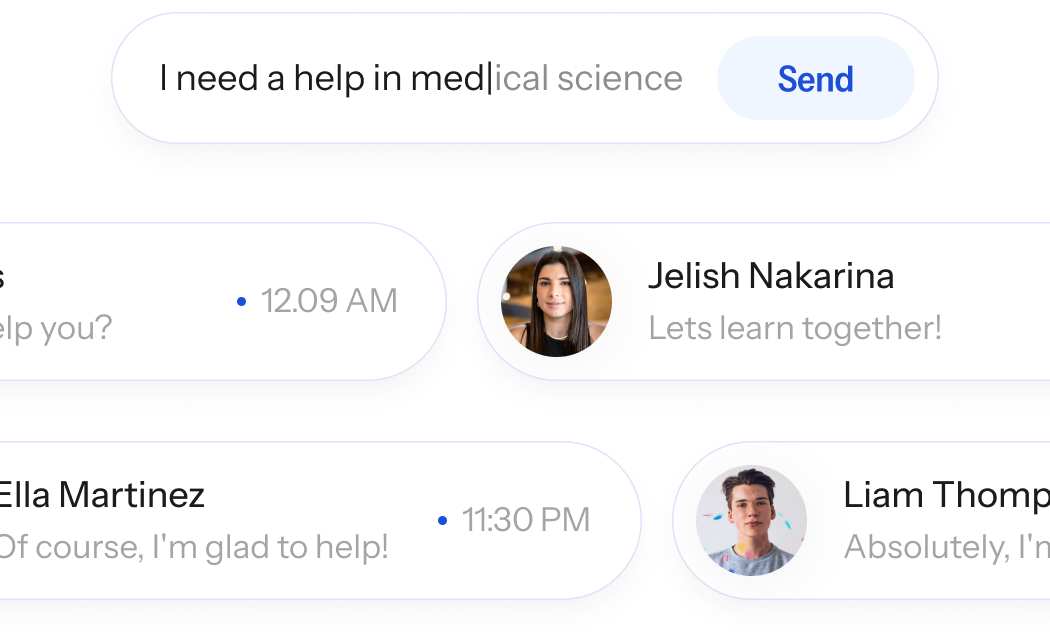
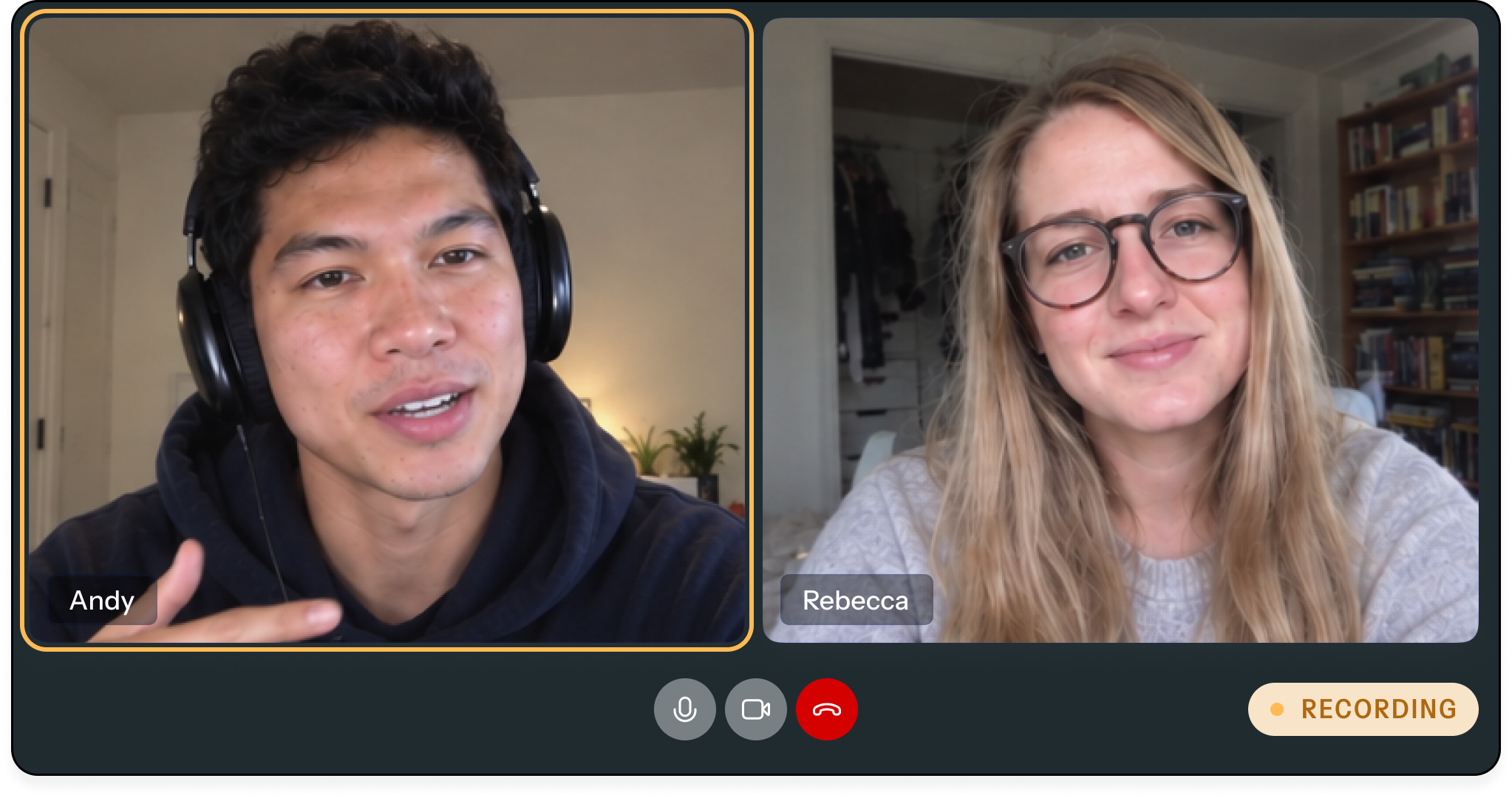
Most people only ever practise with one or two friends. Study Groups connect you with candidates right across the country sitting the same ENT HST interview.
Live MocksBeta

Practise interview technique with different candidates
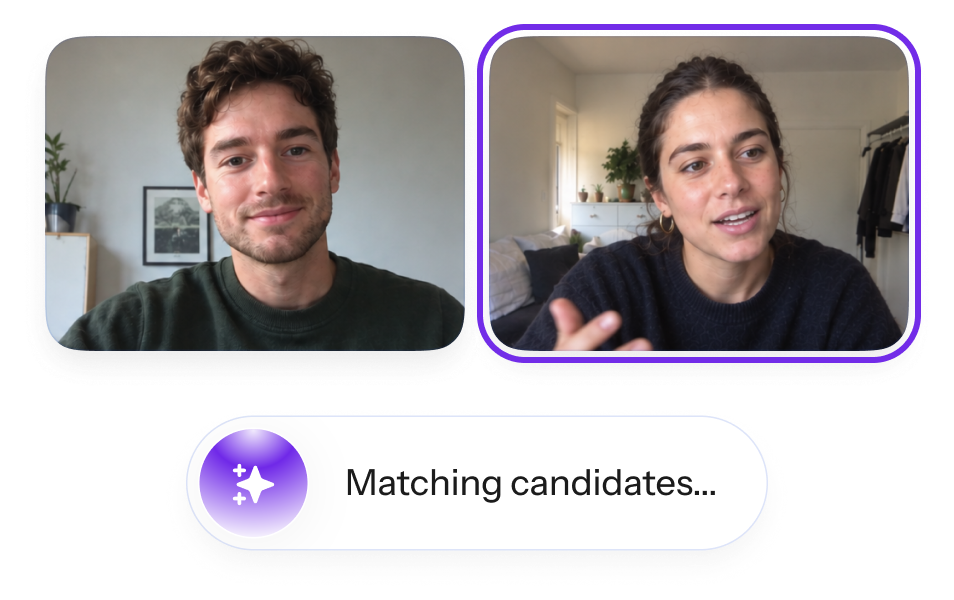
Arrange or get matched on demand with other candidates and run real scenarios out loud under interview conditions. Those who practise with the widest range of people tend to score the highest.
Peer FeedbackBeta

Reviewed by candidates across the platform

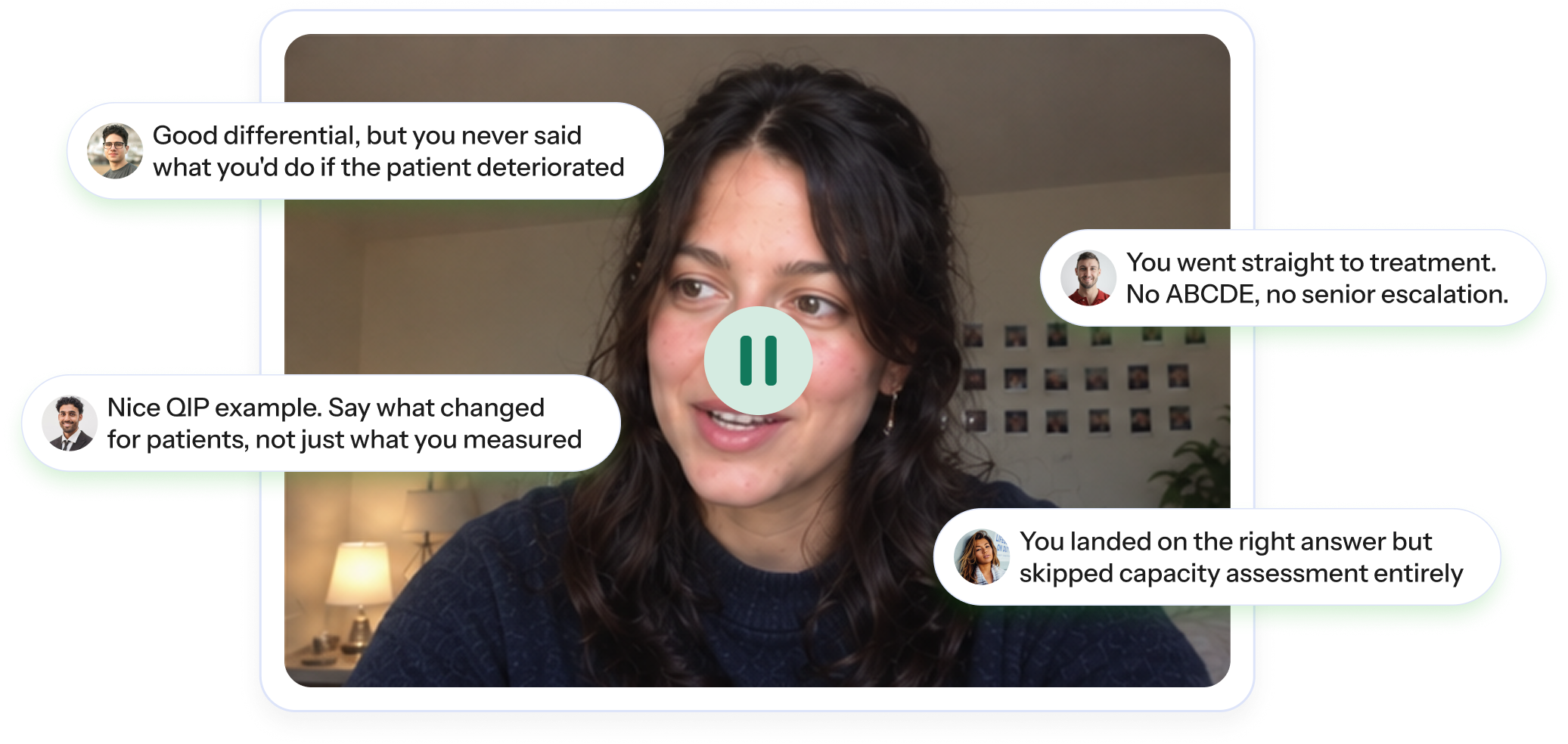
Submit your recorded mocks to candidates across the platform and get honest, varied feedback. Reviewing other people's mocks teaches you just as much.

The question bank, and other candidates to practise with, all in one platform.

ENT HST Revision Platform • €170

Gain access to 54 scenarios and over 230 model-answered questions across all five scored stations, and collaborate with other candidates through Study Groups, Live Mocks and Peer Feedback.
Get instant access
Part 1 • See the questions

The Medibuddy ENT HST Question Bank

The interview is marked station by station, with each panel member scoring you independently, so every point has to land, and knowing how to structure each answer is essential. That's why each of our 54 scenarios comes with a model answer, written to the RCSI selection criteria and Irish practice, so you know exactly how to approach every question the panel throws your way.
What's inside

What's included in the ENT HST Question Bank

There's nothing worse than getting to the interview and being handed a scenario you've never seen before. The panel scores you across five stations, from quality and safety to decision making in surgery, so the safest approach is to revise across all of them. We provide scenarios for every station, covering the common presentations and the less common ones, so you don't get caught out.

Quality and safety in surgical healthcare

10 scenarios and 42 questions. Short ENT scenarios on patient safety and governance: the WHO Surgical Safety Checklist, throat packs and retained items, airway fire in laser surgery, tracheostomy and laryngectomy safety, wrong-side ear surgery, and NIMS reporting and open disclosure under the Patient Safety Act 2023.

Commitment to academic advancement and lifelong learning

10 scenarios and 30 questions. Your own research, audit and teaching, critical appraisal and research governance, illustrated with ENT examples, with model answers that show how to present your portfolio with confidence.

Knowledge of current issues relevant to surgical practice

10 scenarios and 34 questions. Irish ENT service knowledge: NTPF waiting lists, the 2019 ENT model of care and the shift to primary care and audiology, head and neck cancer services, HPV and oropharyngeal cancer, the cochlear implant programme, newborn hearing screening, workforce planning and surgical hubs.

Decision making in surgery

14 scenarios and 92 questions. Clinical scenarios where you are the ENT registrar on call: assess, prioritise, decide, consent and escalate to your consultant. Covers airway emergencies, epistaxis, post-tonsillectomy bleeding, deep neck space infection, foreign bodies, facial nerve palsy, sudden sensorineural hearing loss, neck lumps and paediatric ENT.

Professionalism and probity in surgical practice

10 scenarios and 36 questions. Scenario-led questions on honesty and integrity: consent and delegation under the Medical Council Guide (9th edition), the HSE National Consent Policy, the Assisted Decision-Making (Capacity) Act 2015, open disclosure, and probity in private practice and waiting lists.
Reflecting how ENT HST is really assessed
Our scenarios and model answers are written to the current RCSI interview structure, across all five scored stations.
Try it

Try an example ENT HST question

You are the ENT registrar on call. The Emergency Department calls you about a 22-year-old woman who had a routine tonsillectomy six days ago. She has come in spitting blood into a bowl for the past 45 minutes. She is pale, heart rate 118, blood pressure 96/64, saturations 97% on air. She is anxious and distressed. Your consultant is at home.

How would you approach this?

Question
How would you approach this patient immediately?
Example answer
This is a secondary post-tonsillectomy haemorrhage with haemodynamic compromise, which is a surgical emergency. I would act simultaneously on her airway, circulation and the need to escalate.
  • Immediate actions: summon the on-call anaesthetist now and contact my consultant by phone.
  • Move her to the resuscitation room; continuous monitoring of saturations, heart rate, blood pressure and ECG.
  • Two large-bore IV cannulae; send blood urgently for FBC, group and crossmatch, clotting, urea and electrolytes, and a venous lactate.
  • IV fluid resuscitation with warmed crystalloid while awaiting blood products.
  • Have suction and difficult airway equipment at the bedside; note the volume of clot in the bowl.
  • History to gather rapidly: time of surgery and which hospital; technique used (cold steel, bipolar, coblation).
  • Time haemorrhage started and estimated blood loss.
  • Previous haemorrhage since discharge; any antiplatelet or anticoagulant use; bleeding history or family history of coagulopathy.
  • Whether she has swallowed any blood (which underestimates true loss).
Question
How do you risk-stratify a post-tonsillectomy haemorrhage, and what features here make this patient high risk?
Example answer
Risk stratification guides how urgently I take the patient to theatre and helps me brief my consultant clearly.
  • High-risk features in this patient: active haemorrhage ongoing for 45 minutes with blood visible in the oropharynx.
  • Haemodynamic instability: tachycardia of 118 and blood pressure of 96/64 suggest significant volume loss.
  • Day six post-operatively: secondary haemorrhage (days five to ten) is often arterial from sloughing of eschar and can be more severe than primary bleeding.
  • Age 22: adult vessels are larger and bleed more than in young children.
  • Other features that would escalate concern further: clot in the fossa (a sentinel bleed can precede a torrential haemorrhage); estimated blood loss greater than 250 ml, or haemoglobin drop of more than 20 g/L from baseline; coagulopathy, anticoagulant use, or a known bleeding disorder; inability to tolerate oropharyngeal examination due to active bleeding.
  • Low-risk features (not present here) that might allow conservative management: haemodynamically stable, haemorrhage self-limiting or already stopped on arrival; minimal blood loss, clear fossa on examination, clotting normal.
Question
You examine her oropharynx and see an active arterial bleeder in the right tonsillar fossa with a large clot. What are your immediate bedside measures while you prepare for theatre?
Example answer
The priority is temporary haemostasis and protection of the airway while the patient is being prepared for theatre.
  • Bedside haemostatic measures: sit her forward to reduce blood aspiration; suction the oropharynx carefully.
  • Ask her to gargle and hold cold water or ice in her throat: vasoconstriction can reduce bleeding temporarily.
  • Apply an adrenaline-soaked (1:10,000) swab to the fossa using Tilley's or Magill's forceps and firm pressure, held for several minutes.
  • Tranexamic acid 1 g IV as an antifibrinolytic agent.
  • Resuscitation in parallel: activate a major haemorrhage protocol if blood loss is significant; request O-negative or group-specific blood.
  • Correct any coagulopathy with FFP and platelets as guided by point-of-care testing or clotting results.
  • Inform the blood bank and the on-call haematologist if needed.
  • Escalation: phone my consultant with a clear SBAR briefing that she needs theatre now.
  • Notify the anaesthetic team and theatre coordinator; arrange the most senior available anaesthetist.
Question
Your consultant agrees she needs to go to theatre. What are the specific anaesthetic and surgical challenges you need to anticipate and plan for?
Example answer
Post-tonsillectomy haemorrhage carries a high anaesthetic and surgical risk and needs a joint plan agreed before induction.
  • Anaesthetic challenges: a full stomach from swallowed blood means a high aspiration risk, so rapid sequence induction is usually preferred.
  • A blood-filled, distorted oropharynx makes laryngoscopy and intubation difficult; video laryngoscopy and a smaller tube should be planned.
  • Haemodynamic instability increases the risk of cardiovascular collapse at induction; blood and vasopressors must be available.
  • I will be present at induction, scrubbed and ready to act if there is sudden torrential haemorrhage obstructing the airway.
  • Surgical planning: the Rose position with head extension gives the best access to the fossa.
  • The usual approach is bipolar diathermy to the bleeding point under direct vision; suture ligation is an alternative if diathermy fails.
  • I will identify the vessel clearly before applying diathermy to avoid injury to adjacent structures including the internal carotid artery.
  • If the fossa is dry on examination under anaesthesia and the source is not identified, packing with a haemostatic agent can be used and the patient observed.
  • Complete the WHO Surgical Safety Checklist including confirmation that blood is available.
Question
In theatre you find the bleeding is from a large vessel in the right fossa and despite bipolar diathermy the bleeding continues. What do you do?
Example answer
Persistent haemorrhage after diathermy is a serious intraoperative emergency requiring rapid escalation and a change in strategy.
  • Immediate steps: call my consultant to come in immediately if not already present; ask the anaesthetist to call for additional senior anaesthetic support.
  • Apply firm pressure with a swab to the fossa while I reassess.
  • Ask for additional suction, better lighting and a longer sucker if visualisation is limited.
  • Surgical options: attempt suture ligation of the bleeding point with a figure-of-eight absorbable suture; apply a haemostatic agent (oxidised cellulose or a gelatine sponge) with sustained pressure; if bleeding persists, place a haemostatic pack in the fossa and oversew the tonsillar pillars over it.
  • Escalation: if bleeding is still uncontrolled, keep pressure on the fossa and get urgent interventional radiology or vascular input; angiography and endovascular embolisation of the lingual or facial artery is a recognised option for refractory haemorrhage from the tonsillar fossa; external carotid ligation through a neck incision is the last resort for exsanguinating haemorrhage, done with my consultant present and scrubbed.
Question
The haemorrhage is controlled and she is admitted. How do you manage her post-operatively, and when is it safe for her to go home?
Example answer
Post-operative care after a secondary tonsillar haemorrhage requiring return to theatre is more intensive than after routine tonsillectomy.
  • Post-operative management: HDU or a monitored bed for the first 12 to 24 hours, with observations every 30 minutes, watching for re-bleeding (rising heart rate, falling blood pressure, haematemesis).
  • IV access maintained; continue IV fluids until she is tolerating oral intake.
  • IV tranexamic acid for 24 hours; continue until haemostasis is well established.
  • Analgesia: regular paracetamol and ibuprofen; avoid aspirin.
  • Antibiotics such as IV co-amoxiclav, as per local protocol, stepping down to oral to complete about a week.
  • Haematology review if clotting was abnormal or blood products were given.
  • Dietitian input if oral intake is poor.
  • Discharge criteria: at least 12 to 24 hours without any evidence of re-bleeding.
  • Haemodynamically stable and eating and drinking adequately.
  • Haemoglobin checked; transfusion if symptomatic anaemia.
  • Clear written discharge information: return immediately if any further bleeding, clots or haemoptysis.
  • Follow-up arranged in ENT outpatient clinic within one to two weeks.
  • Consider whether the index operative note and technique should be reviewed before she is discharged.
Question
On further questioning she tells you she has always had heavy periods and bled for days after a dental extraction. How does this change your management?
Example answer
This history suggests an inherited bleeding disorder, most commonly von Willebrand disease, which would explain a haemorrhage of this severity and changes both her immediate care and any future surgery.
  • Investigations: a standard clotting screen is often normal in von Willebrand disease.
  • Discuss with haematology: von Willebrand factor antigen and activity, factor VIII level, and a platelet function test.
  • Take samples before giving blood products where possible, as transfusion can mask the result.
  • Immediate management, guided by haematology: continue tranexamic acid.
  • Desmopressin (0.3 micrograms per kg) if she is likely to respond, or von Willebrand factor concentrate for more severe disease.
  • Avoid NSAIDs until the diagnosis is clear; use paracetamol and other analgesia instead.
  • Keep her in a monitored bed with a lower threshold for return to theatre.
  • Afterwards: refer to the National Coagulation Centre at St James's Hospital for diagnosis and a treatment plan; any future surgery or dental work should be planned with haematology in advance; inform her GP and document the suspected diagnosis clearly.

That's one scenario. There are 53 more.

ENT HST Revision Platform • €170

Includes every scenario in the Question Bank, and access to Study Groups, Live Mocks with other candidates and Peer Feedback.
Get instant access
New for 2027

Built around the current interview structure

The ENT HST interview changes from year to year, and the biggest fear for any candidate is getting to interview day and realising you've revised with a question bank that doesn't match the format.

That's why this Question Bank is new for the 2027 interviews, built from the start around the current published RCSI interview structure and anchored to Irish practice, guidelines and law.

Our scenarios and model answers are aligned with the current interview structure, across all five scored stations, so you practise with the format the panel is using now.
New for 2027 interviews
Part 2 • Practise them live

The only interview resource where you can practise live with other candidates from across the country

Our ENT HST Question Bank tells you exactly how to answer real interview scenarios. But how you practise with them will determine how many marks you score. Simply reading answers off a screen won't prepare you for the intense scrutiny you'll face in the interview. And only practising with the same few colleagues or friends limits the amount of feedback you'll get. Medibuddy gives you unique access to ENT HST candidates across the country, so you can learn from a variety of perspectives and hear a far wider range of feedback than your own circle could ever give you.
Study Groups
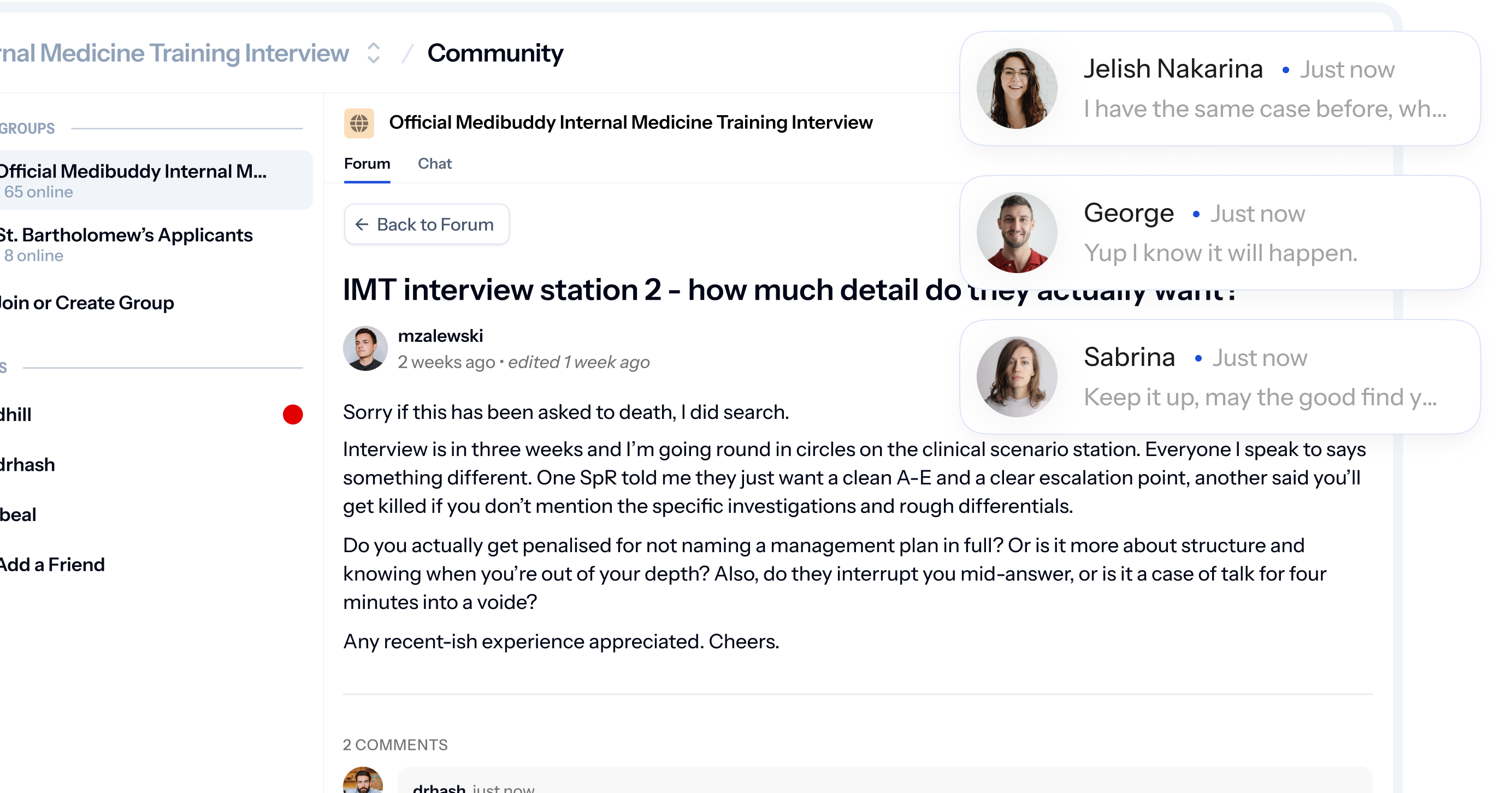
When you prepare in isolation, you're relying on your own interpretation of the interview process, which is one of the quickest ways to get found out on the day. Study Groups connect you with other doctors across the country who are also applying to ENT HST, so you can engage and network with people preparing for the same interview as you. Everyone brings different experience from different hospitals, meaning you won't ever miss out on the key bits of information that could swing the interview in your favour.
Live MocksBeta
Candidates who don't take part in mocks often struggle to adapt to the pressure of the interview. Your knowledge might be correct, but without convincing delivery the interviewers will score you poorly. The best way to improve your delivery is to take part in as many live mocks as possible, which is why we haven't put a cap on how many you can do. We also know how difficult it can be to organise mocks with other people, so all you have to do is join the waiting room and we'll match you with a different ENT HST candidate each time. Take turns as both the interviewer and candidate on real Question Bank scenarios, so you can see exactly how other candidates perform in real time, while refining your own interview technique.
Peer FeedbackBeta
Preparing alone means you won't know how you're coming across during the interview. And preparing with the same few candidates means you'll miss opportunities to improve, which is why it's so important to get as many opinions as possible on your performance. With Medibuddy, you can record a mock and submit it for feedback from other candidates on the platform, so you receive a wider range of feedback and refine your answers with each person you practise with. Reviewing other people's mocks is just as valuable, as it shows you how strong candidates handle the same scenarios, which is one of the fastest ways to improve.
The interview

What to expect from the ENT HST interview

Higher Surgical Training in Otolaryngology, Head and Neck Surgery is run by RCSI through the National Surgical Training Programme: a six-year Specialist Registrar programme that follows Core Surgical Training. RCSI gives an indicative appointable range of 6 to 8 ENT posts for 2027, with interviews in the week commencing 15 March 2027 and training starting on 12 July 2027.

Station

Quality and safety in surgical healthcare

Worth 100 marks on the Pathway and 80 on the Equivalent Standards Route (ESR). Patient safety, governance and quality improvement in ENT practice. RCSI does not publish the format, so be ready to work through a short scenario, say what you would do, and explain how the team and the service should learn from it.
Station

Commitment to academic advancement and lifelong learning

Worth 40 marks on the Pathway and 80 on the ESR. Expect questions on your own research, audit and teaching, and on critical appraisal. Pathway candidates also carry a separate 40-mark academic score assessed before interview.
Station

Knowledge of current issues relevant to surgical practice

Worth 100 marks on the Pathway and 80 on the ESR. The panel tests your knowledge of the Irish health service and ENT within it. ENT had 46,274 adults and children on the NTPF outpatient waiting list in September 2026, the fourth-largest outpatient specialty, so be ready to discuss access, models of care, cancer services and workforce.
Station

Decision making in surgery

Worth 120 marks on the Pathway and 80 on the ESR, and a mandatory pass station: you need at least 60 per cent, and failing it makes you not appointable whatever your overall score. Both the higher weighting and the pass rule are new for 2027. As the on-call ENT registrar, show a safe, structured approach and clear escalation to your consultant.
Station

Professionalism and probity in surgical practice

Worth 100 marks on the Pathway and 80 on the ESR. Probity means honesty and integrity, not only conduct. Show that you know the Medical Council Guide, the HSE National Consent Policy and the Assisted Decision-Making (Capacity) Act 2015, and that you would act on them under pressure.

How the interview is scored

Two or three panel members score each station out of 100 independently, and the scores are averaged and weighted to the station marks. On the Pathway the interview is worth 460 marks (100, 40, 100, 120 and 100), and on the ESR it is worth 400 (80 per station). You need at least 60 per cent of the interview overall, and at least 60 per cent in Decision making in surgery. Our model answers are structured against these stations, so you know what a strong, well-organised answer looks like in each one.
Get ready

How to prepare for the ENT HST interview

Start with the Question Bank

Work through 54 scenarios across all five scored stations, each with a model answer. Start by reading how a strong answer is formed, then think about how you'd deliver it.

Talk the hard ones through in Study Groups

Study Groups are your biggest opportunity to network and connect with other candidates sitting the same interview as you. Everyone on the platform is in the same boat, so don't be scared to get involved and ask questions. Someone in your study group might just help you work through a scenario you've been struggling with.

Rehearse out loud in Live Mocks

Live mocks are where you begin to put everything you've learned into practice, and we know from experience that those who practise with a wide range of candidates usually do the best. Organise mocks with people from one of your study groups, or get matched with a random ENT HST candidate, then take turns as interviewer and candidate using real scenarios until answering out loud under pressure feels normal.

Get reviewed with Peer Feedback before the day

Once you've recorded a mock, you can have other community members review it. This lets you see how you come across to other people, and gives you time to refine your delivery as you revise, rather than being caught out on the day. Reviewing other people's mocks is just as crucial, as you see how other candidates navigate the same scenarios.
Questions

Frequently asked questions

What does the ENT HST interview involve?
Five scored stations, each marked independently by two or three panel members: Quality and safety in surgical healthcare (100 marks on the Pathway), Commitment to academic advancement and lifelong learning (40), Knowledge of current issues relevant to surgical practice (100), Decision making in surgery (120) and Professionalism and probity in surgical practice (100). On the ESR every station is worth 80. Decision making in surgery is a mandatory pass station at 60 per cent. Our scenarios and model answers cover all five stations.
How competitive is the ENT HST interview?
Highly competitive. RCSI's indicative appointable range for ENT in 2027 is 6 to 8 posts, and from 2027 you must pass Decision making in surgery as well as reach 60 per cent of the interview overall, which is why a structured, well-rehearsed approach matters.
Who writes the model answers?
Written by our team of medical writers and reviewed against the current RCSI selection criteria and Irish guidance.
Can I practise with other candidates?
Yes. Every Revision Platform purchase gives you the opportunity to connect with other candidates through Study Groups, Live Mocks and Peer Feedback.
How do the Live Mocks work?
All you have to do is join the waiting room, and we match you with another ENT HST candidate. You then take turns as interviewer and candidate on real Question Bank scenarios, so you gain experience answering out loud to a real person before you ever sit in front of the panel.
What are Study Groups and how do they help?
Study Groups are community forums for doctors across the country preparing for the same ENT HST interview. You can ask questions, share what you're struggling with, and compare how you'd approach a scenario.
Can I get feedback on my interview performance?
Yes. After you've recorded a mock, you can ask other members to review it, so you can see which part of your answer needs fine-tuning.
How long do I get access for?
Access runs for 12 months from the purchase date.

Start preparing for the ENT HST interview

The Revision Platform gives you 54 scenarios and over 230 model-answered questions to practise and refine with other candidates through Study Groups, Live Mocks and Peer Feedback.

ENT HST Revision Platform • €170

Buy Now