


 Close
Close

 13th January 2026
Ireland’s BST General Internal Medicine Application and Interview 2026
Medibuddy Team — 13 January 2026Whether you trained in Ireland or abroad, the Basic Specialist Training (BST) programme in General Internal Medicine (GIM) offers a critical next step for doctors who want to sharpen their clinical skills, explore a wide range of subspecialties, and progress toward Higher Specialist Training (HST). It’s a structured, hands-on experience that equips you to thrive in a wide range of hospital settings, both regional and tertiary, while offering opportunities for research, mentorship, and professional development.
BST in GIM isn’t just a formality; it’s a formative stage in your career that will shape your clinical thinking, bedside manner, and future trajectory. With limited places and a competitive GIM application process, preparation matters. Whether you’re completing an internship, working in a service role, or already holding NCHD experience, understanding how to plan and present your application can give you a real edge and help you secure a GIM interview.
Why choose BST in GIM in Ireland?
Ireland’s specialty training in GIM offers a superb blend of clinical exposure, supportive mentorship, and clear progression pathways. Doctors with a special interest in core medical competencies will benefit from the structured training programme with formal support and clear progression goals. In addition, many pathology specialities require completion of the BST, including microbiology, immunology, chemical pathology, genetics, and anatomical pathology.
The Irish training environment offers a mix of tertiary and regional hospitals, giving successful applicants a broad base of experience before heading further into Higher Specialist Training (HST) in their preferred speciality. Irish hospitals have an excellent track record of supportive training structures and a strong research culture while providing a good work-life balance, making them an attractive choice for aspiring physicians.
The BST GIM application process: an overview
In broad strokes, the BST application process is the same as an application to medical school, a postgraduate degree or a job application, and should be treated as such. However, this competitive application process differs in that it spans several months between the application and the GIM interview.
Applications are done through the Royal College of Physicians of Ireland (RCPI), and the 2026 application cycle runs from 2 September to 29 September 2025.
More key application dates can be found below:
| Activity | Date |
|---|---|
| BST Applications Open | 02 September 2025 | 12:00pm (Irish Standard Time IST) |
| BST Application Webinar Support 1 | 10 September 2025 | 7:00pm (IST) |
| BST Application Webinar Support 2 | 22 September 2025 | 1:00pm (IST) |
| Zoom Drop in 1 | 24 September 2025 | 3:00pm (IST) |
| Zoom Drop in 2 | 26 September 2025 | 10:00am (IST) |
| Applications Close | 29 September 2025 | 12:00pm (IST) |
| Application Verifications Complete | 17 October 2025 |
| Shortlisting Outcomes | 07 November 2025 |
| Successful Candidates Interview Date/Time Released | 14 November 2025 |
GIM Applicants will be required to submit an up-to-date curriculum vitae (CV) and supporting documents to prove they meet the eligibility requirements (see below).
Foreign-trained applicants have additional requirements to fulfil, including English language proficiency tests. After the CVs are screened for eligibility, scored and ranked, the majority of applicants are called to an interview, and further assessed on their clinical acumen, competency and academic prowess.
Finally, after applicants are scored, successful candidates will be offered choices for centres where they would like to complete the BST. The BST uses a hub and spoke training structure, and applicants will rank the choices for which hub/centre they would prefer to work at. Higher-scoring candidates are given an advantage in these rankings, so it is in the applicant’s interest to score as high as possible to secure a place in the training centre and training rotations of their choice.
BST GIM eligibility criteria: minimum requirements vs what successful applicants really have
The stated minimum requirements from the RCPI BST application programmes are that an applicant:
- must have completed their internship by the start date of the programme
- must clearly demonstrate their eligibility for registration with the Irish Medical Council (IMC)
- must have proof of competency in the English language in line with HSE guidance
- must be eligible to work in Ireland at the time of application
- must be competent in intravenous cannulation, phlebotomy, and nasogastric tube placement.
The stated GIM entry requirements are supremely achievable by most doctors who have completed their internship, and do not reflect the actual threshold for entry into the programme. In fact, several other competencies are assessed throughout the application process, which is why advance planning, smart selection of additional academic pursuits and GIM interview practice is paramount for success.
The practical, actual requirements for successful application are more stringent. Successful candidates are scored on their academic achievements (that is, the centile or decile position within their graduating class), publications in academic journals or at conferences, or completion of audits and quality improvement projects.
Master’s and doctorate degrees provide a small number of points for a candidate (specifically, 2 points for a master’s and three points for a doctorate). The paucity of recognition for these postgraduate degrees reflects the expected emphasis on clinical and research endeavours.
A co-authorship in an international journal publication is worth the same amount of points as a master’s degree. Each section of the rubric also has a maximum score. Use this information in Table 1 to your advantage when planning to improve your CV:

Applicants will also need appraisals signed by two consultants who know you, in a standard format supplied by the RCPI.
Using the online portal from the Royal College of Physicians of Ireland (RCPI)
Applications open online through the RCPI website and application portal. Applicants will be required to submit their CV, as well as a personal statement about their experience and reasons why they are applying to the scheme.
The “Why” is almost as important as the “How”. It is a good idea to reflect on the genuine interest you have in your chosen career well before your application. The median applicant will be around 28 years old when they apply, and can expect to spend more years working than they’ve lived so far.
This time will be spent learning, working, making a difference, communicating, writing, and pursuing excellence. I write this not to frighten the reader, but to encourage a genuine, critical appraisal of your motivations, as this will be the kernel of truth you should convey in your personal statement and interview. This unique, truthful answer to the ubiquitous “why” everyone carries around will distinguish you from a lacklustre candidate as much as a good CV or a clever interview will.
How to strengthen your GIM application and maximise your chances of success
Understanding what constitutes a good BST GIM CV for a competitive application means you can start building your experience.
Make sure to request your centile position in your graduating class, as this can take some time, and counts towards a large portion of the initial score. Around a year in advance, try to identify research you can feasibly conduct and publish before the application date. Poster presentations at conferences that also publish a conference journal are ideal for this. Be sure to use the correct Vancouver citation when adding any publications to your CV.
Another strategy is to integrate yourself with a high-output researcher in your current role, perhaps a consultant or a specialist registrar who needs a hand with data collection, data analysis or a general busybody to complete their current (approved) research in exchange for a co-authorship.
Whether you have many publications or few, be sure to focus your CV around your expertise in research, rather than a tally of what you have done. Most publications receive fewer than 5 citations, so a highly cited study may be more of a talking point in your interview than more numerous, less impactful publications.
Remember that non-experimental research, such as narrative literature reviews, scoping reviews or case reports, is quick and is immensely publishable to the right conference or journal.
If you cannot feasibly complete research before the applications open, try to enrol in short courses that showcase research skills. Evidence synthesis Ireland offers a range of systematic review training opportunities, which are a useful skill to have as a researcher and aid in critical evaluation of research – a handy skill for any clinician.
Coursera offers a variety of research short courses, including some in statistics for public health or AI in healthcare, that will benefit your practice and add a line to your CV.
HSeLanD has a number of free courses hosted by the HSE, beyond those required for practice, that may be of interest and are worth a number of CPD points.
The AMRIC series on antimicrobial stewardship would be a great addition to a CV for anyone interested in infectious diseases, public health or occupational health.
Lastly, the RCPI offers a number of short courses, certificates and diplomas as standalone courses or as part of the CPD-SS that can be added to your repertoire of completed learning engagements.
9 Months Out
At about 9 months from the BST GIM application, you should start gathering evidence for your academic and professional portfolio. Consider presenting at journal clubs, grand rounds, or volunteering to teach medical students.
Complete audits or volunteer to aid ongoing quality improvement projects. There are a number of national audits that are usually coordinated by your hospital’s quality improvement office – a phone call to them would be a great way to get involved.
6 Months Out
At 6 months out, start by drafting your CV. Review the requirements and ensure your CV meets the RCPI’s requirements for BST in General Internal Medicine. Make sure you have completed the required English language proficiency tests, where applicable.
Submit the appraisal documents to the consultants you’ve identified, who will give you an honest but favourable appraisal. You only need two appraisals completed, but it is advisable to ask three or more consultants to complete the documents, allowing you the convenience of choice on which to submit.
3 Months Out
Three months from submission, you should have your CV refined and all the documents in order. Take the last three months to tie up any loose ends and complete any courses you can to boost your CV to guarantee a strong BST GIM application.
Your CV should showcase sustained commitment to medicine: rotations in acute and subspecialty settings, leadership roles, presentations, publications, and teaching. You should use concise descriptions, quantifiable outcomes (e.g., audit re-audit percentages, number of citations of research).
Use the weights of relevant domains to guide your CV, focusing on academic achievement, research and professional development separately. Your CV should be succinct, clear and measurable and connected to the outcomes.
What makes your application stand out?
In recent years, most applicants who applied and met the minimum requirements were invited to interview. This translates to hundreds of applications for the RCPI to screen and review. Clear CVs that are easy to award points will perform better than wordy, long, and confusing CVs.
Your personal statement and the appraisals from your consultants are some of the areas where you can stand out in the shortlisting process. A personal anecdote or a novel reason for pursuing GIM will always be welcomed by assessors.
In my application, I shared an anecdote about the first time I saw a malaria protozoite through the lens of a microscope and knew I wanted to pursue infectious diseases. A relatable, real, memorable anecdote may make all the difference.
The BST GIM Interview
The 2026 GIM online interview dates are: 20, 21, 22, 27, 28 & 29 January 2026. Each interview typically takes 15 minutes and has 5 questions.
The first question will require you to talk through your CV, and the following 4 questions vary. Interview preparation makes all the difference. Anticipating what may be asked and practising responses to possible questions in advance does more than soothe the nerves.
A well-polished interview from a presentable candidate with a structured, clear CV will mean better scores from the panel. Making a good first impression cannot be overstated here.
Interviews are weighted more heavily than CVs, and your responses to the clinical and ethical questions make up 60% of the final score. You can find the interview scoring guidelines here.
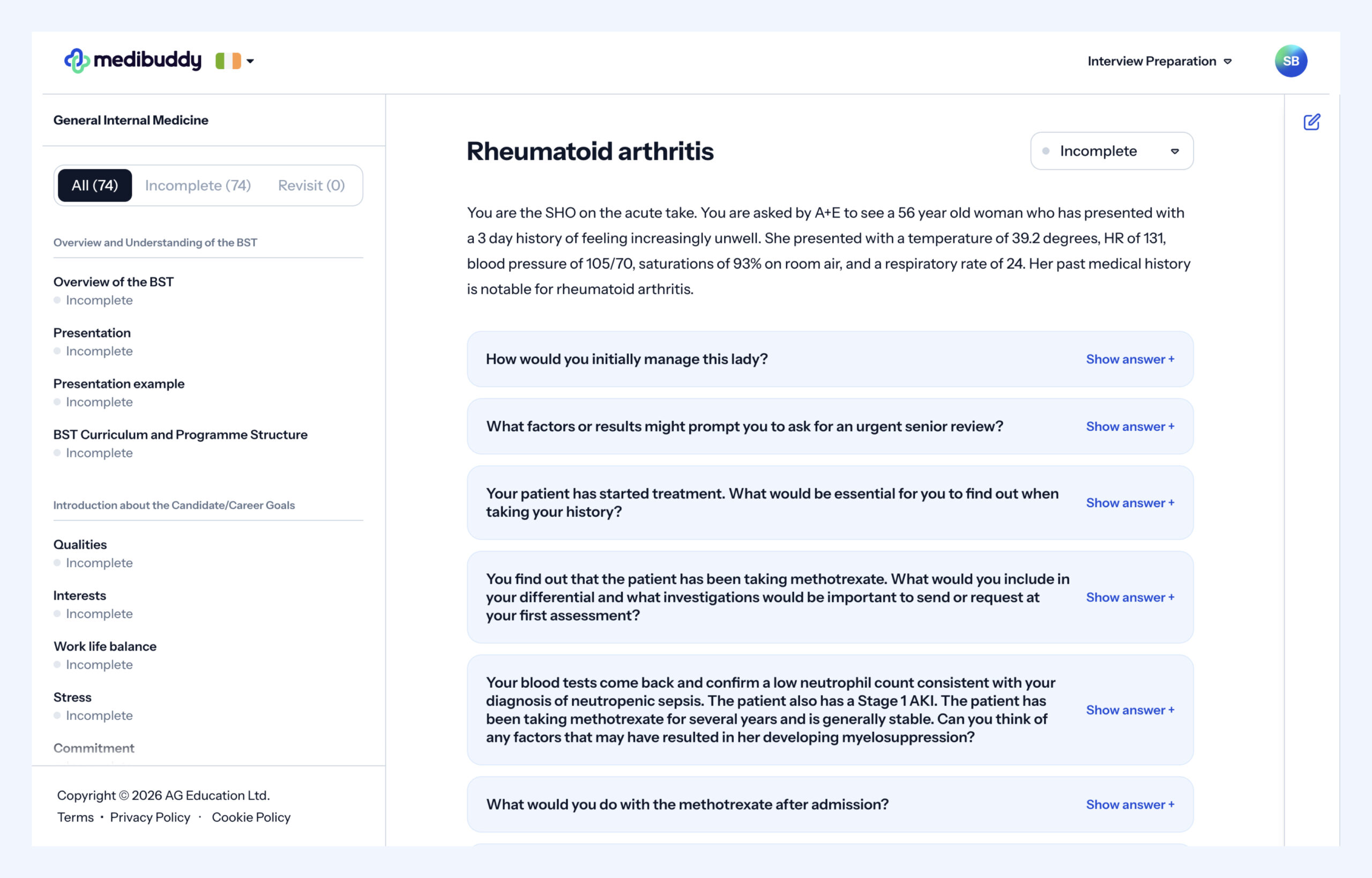
Below is an example of a clinical scenario from our BST GIM Question Bank, designed to help you practise the types of questions you can expect on interview day.
From Application to Appointment: The BST GIM Journey
Following your interview, a panel will tally your score. Successful applicants will be contacted around April and given an opportunity to rank their choice of training hub.
Following the allocation of the training hub, applicants will be asked to rank their choice of rotation. The rankings are done online via the RCPI portal. In both cases, your application score (the combined score out of 100) will be taken into account, and higher scorers will be preferentially allocated to their choices.
Candidates are divided into two groups for the purpose of ranking and allocation. Group 1 includes: Irish, UK, EU nationals, and holders of Stamp 4 or Stamp 4 EUFAM. These candidates must be treated equally in the ranking and allocation process, as required by EU law.
Group 2 includes: holders of Stamp 1G and Stamp 1H (typically associated with medical posts or education provisions). Places in the BST are allocated in the first instance to applicants who, at the time of application, are considered Group 1. And offers may only be made to candidates in Group 2 once the pool of qualified candidates in Group 1 has been fully considered and exhausted, based on ranking.
Applicants who are not immediately successful are ranked in order based on their combined scores. There are a number of cancellations each year, mostly from applicants who apply to several training schemes or decide to seek greener pastures abroad, so not all hope is lost if you are not successful in the first round.
However, despite an expanded number of training posts, the competition for these posts is increasing, highlighting the need for adequate preparation for the interviews.
An induction process happens between May and June, and is hosted in a hybrid learning environment. Map out the post-interview timeline: when offers are typically released, the acceptance deadline, and induction processes.