Histopathology HST • Ireland

The 2027 Histopathology HST Interview Revision Platform: Question Bank, Live Practice and Mocks with Other Candidates

The Medibuddy Histopathology HST Question Bank includes 96 scenarios and over 400 model-answered questions across all five scored categories, each with a model answer written to the RCPI Faculty of Pathology selection criteria and Irish practice.

However, knowing a strong answer isn't the same as delivering it well under pressure, which is why we provide:

Preparing doctors for interviews for 10 years

Medibuddy has been helping doctors prepare for competitive interviews for 10 years. The Histopathology HST Question Bank is new for the 2027 interviews, built from the ground up around the five categories RCPI publishes for this interview.

Always up to date

Did you know the interviews change from year to year? For 2027, RCPI's published criteria call the largest Histopathology category BST Performance, where the older criteria called it Career to Date in Pathology. That's why every Question Bank on the platform is built around the latest published interview structure, so you know you're always practising with scenarios that reflect how the interview is scored now.

Network and practise real interview scenarios with other candidates

Question Bank

See every scenario, and how to answer it well

96 scenarios across all five scored categories, which tell you exactly how to respond to each question.
Study Groups

Connect with candidates across the country

Most people only ever practise with one or two friends. Study Groups connect you with candidates right across the country sitting the same Histopathology HST interview.
Live MocksBeta

Practise interview technique with different candidates

Arrange or get matched on demand with other candidates and run real scenarios out loud under interview conditions. Those who practise with the widest range of people tend to score the highest.
Peer FeedbackBeta

Reviewed by candidates across the platform

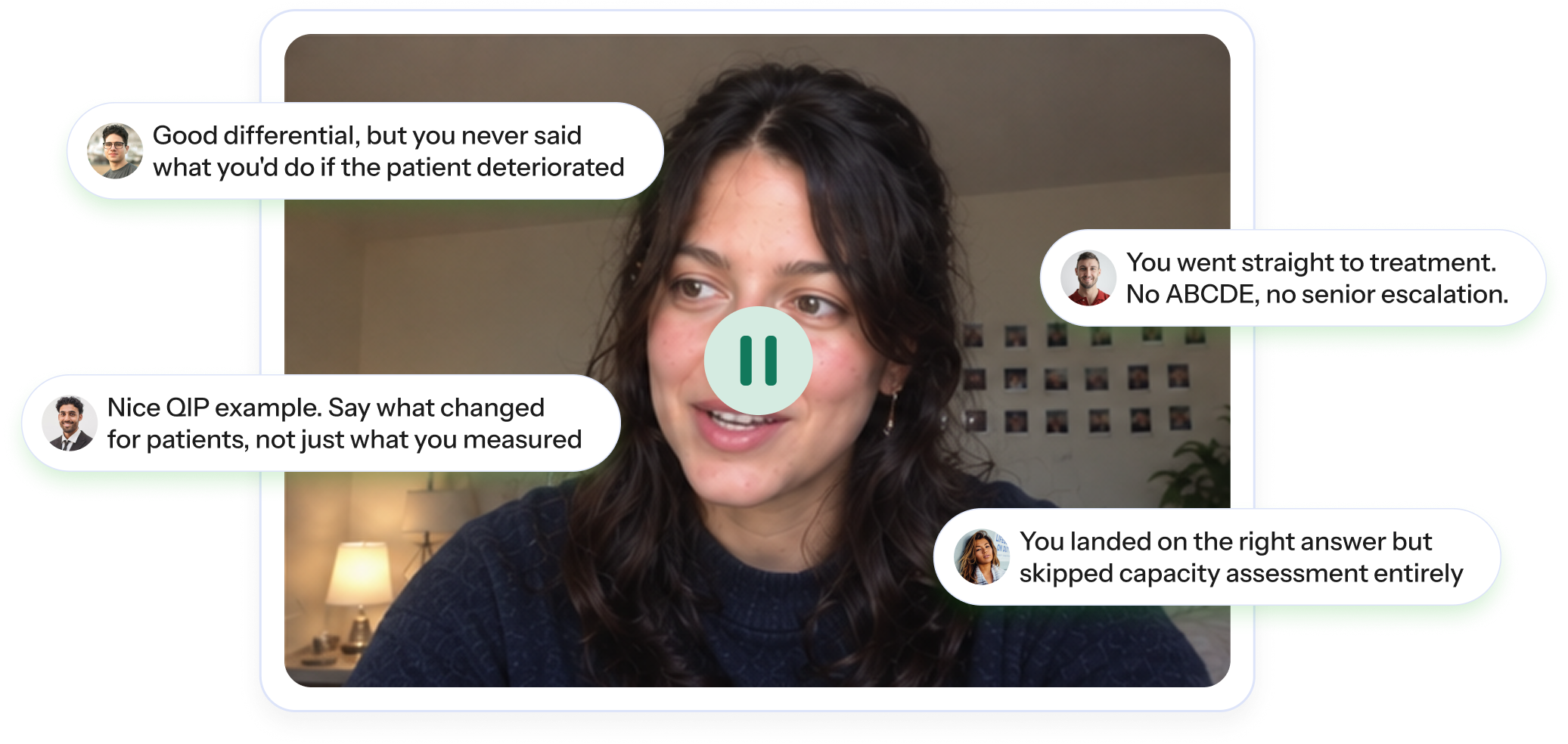
Submit your recorded mocks to candidates across the platform and get honest, varied feedback. Reviewing other people's mocks teaches you just as much.

The question bank, and other candidates to practise with, all in one platform.

Histopathology HST Revision Platform • €170

Gain access to 96 scenarios across all five scored categories, and collaborate with other candidates through Study Groups, Live Mocks and Peer Feedback.
Get instant access
Part 1 • See the questions

The Medibuddy Histopathology HST Question Bank

The Histopathology HST interview is scored across five published categories, so every point has to land, and knowing how to structure each answer is essential. That's why each of our 96 scenarios comes with a model answer, written to the RCPI Faculty of Pathology selection criteria and Irish practice, so you know exactly how to approach every question the interviewers throw your way.
What's inside

What's included in the Histopathology HST Question Bank

There's nothing worse than getting to the interview and being asked about something you've never prepared for. RCPI scores the Histopathology HST interview across five categories, from BST Performance to Presentation / Communication, so the safest approach is to revise across all of them. We provide scenarios for every category, from diagnostic questions at first-year Specialist Registrar level to laboratory quality, professional dilemmas and communication tasks, so you don't get caught out.

BST Performance

Diagnostic and BST portfolio questions asked from the chair of a first-year Specialist Registrar, across surgical pathology, cytopathology, molecular pathology and autopsy, each with a worked answer showing how to reason through the case and when to involve your consultant.

Research & Audit

Questions on your audits, QI projects, publications and presentations, with model answers that link them to Irish anchors such as NHQI turnaround and frozen section metrics and INAB ISO 15189 accreditation, and to research ethics and the use of tissue in research.

Management & Leadership

Your leadership and management experience, from rostering, training and committee work to laboratory quality assurance, with model answers grounded in current Irish pressures: turnaround backlogs, accreditation, MedLIS and the laboratory workforce.

General Suitability

Your motivation, career goals and readiness to step up to Specialist Registrar, alongside professional dilemmas in the laboratory: diagnostic discrepancy, open disclosure, NIMS, the Patient Safety Act 2023 and raising concerns about a colleague.

Presentation / Communication

The communication tasks a Specialist Registrar actually does: presenting a case at MDT, phoning an unexpected malignancy through to a clinician, explaining a deferred frozen section to a surgeon, and explaining post-mortem findings to a family.
Reflecting how Histopathology HST is really assessed
Our scenarios and model answers follow the five interview categories and marks RCPI publishes for the 2027 intake, anchored to Irish laboratory practice, guidance and law.
Try it

Try an example Histopathology HST question

You are the first-year histopathology Specialist Registrar reporting a right hemicolectomy from a 72-year-old woman. It shows a poorly differentiated adenocarcinoma with a pushing border, prominent tumour-infiltrating lymphocytes and a Crohn-like lymphoid reaction. Reflex mismatch repair (MMR) immunohistochemistry shows loss of MLH1 and PMS2 in the tumour nuclei, with retained MSH2 and MSH6. Internal controls stain normally. Your consultant will sign out the case.

How would you approach this?

Question
How do you interpret this staining pattern?
Example answer
This is deficient mismatch repair (dMMR) with loss of the MLH1-PMS2 heterodimer, and the morphology fits a microsatellite unstable tumour.
  • Interpretation: MLH1 loss causes secondary loss of PMS2, its obligate partner; MSH2 and MSH6 are intact. Loss means absent nuclear staining in tumour with positive internal controls in lymphocytes, stroma or normal mucosa. Weak, patchy or subclonal staining is not the same as loss; repeat on a better fixed block if unsure.
  • Morphology: Right-sided site, poor differentiation, a pushing border, tumour-infiltrating lymphocytes and a Crohn-like reaction are all typical of MSI-high tumours.
  • Report: State the pattern, that it indicates dMMR, and that further testing is needed to separate sporadic from inherited causes.
Question
What are the possible causes of MLH1 and PMS2 loss, and what do you request next?
Example answer
In an older patient MLH1/PMS2 loss is usually sporadic, from MLH1 promoter hypermethylation, so test for that before anyone is referred for germline testing.
  • Causes: Sporadic MLH1 promoter hypermethylation, often with BRAF V600E: the commonest cause, especially in older women. Lynch syndrome from a germline MLH1 pathogenic variant, or occasionally PMS2. Rare: constitutional MLH1 epimutation, or double somatic MMR mutations.
  • Next test: BRAF V600E and/or MLH1 promoter hypermethylation testing on the tumour block. BRAF V600E present or MLH1 methylated: sporadic, so no routine germline referral. BRAF wild-type and unmethylated: possible Lynch syndrome, so recommend referral to clinical genetics.
  • Practical: Choose a block with good tumour content and note the tumour cellularity for the molecular laboratory.
Question
BRAF V600E is not detected and MLH1 promoter methylation is absent. What do you do?
Example answer
This raises the possibility of Lynch syndrome, and the report must say so clearly so that the patient and her family can be offered genetic assessment.
  • Report: Give the MMR, BRAF and methylation results with an integrated conclusion. For example: 'these findings raise the possibility of Lynch syndrome; referral to clinical genetics is recommended'. Review with your consultant before sign-out.
  • Communication: Make sure the treating team knows, by phone or at the MDT, rather than relying on the report alone. The referral is made by the treating clinician; germline testing needs genetic counselling and consent.
  • If germline testing is negative: Consider Lynch-like syndrome: tumour sequencing of the MMR genes may show double somatic mutations. Absent tumour methylation makes constitutional MLH1 epimutation unlikely.
Question
How would you interpret isolated loss of PMS2, or isolated loss of MSH6, in another colorectal cancer?
Example answer
Isolated loss of a secondary partner protein usually points to a defect in that gene, so BRAF and methylation testing are not informative and genetics referral is recommended.
  • Isolated PMS2 loss: Usually a germline PMS2 variant (Lynch syndrome). Occasionally an MLH1 variant that leaves non-functional but detectable MLH1 protein.
  • Isolated MSH6 loss: Suggests a germline MSH6 variant. Weak or patchy MSH6 can follow neoadjuvant chemoradiotherapy, so interpret with care.
  • MSH2 and MSH6 loss together: Lynch syndrome from an MSH2 variant or an EPCAM deletion; double somatic mutations are the alternative.
  • Pitfalls: Poor fixation, heterogeneous staining and failed internal controls can all give a false-positive loss pattern. Always read MMR results alongside the morphology and the patient's age.
Question
How does the dMMR result affect this patient's treatment?
Example answer
dMMR status is both prognostic and predictive, which is why it must be clearly stated in the report.
  • Prognosis: Stage II dMMR colon cancer carries a low risk of recurrence compared with proficient MMR disease. Fluoropyrimidine monotherapy gives no benefit in stage II dMMR disease, so adjuvant chemotherapy may be avoided.
  • Prediction: Metastatic dMMR or MSI-high colorectal cancer responds to immune checkpoint inhibitors such as pembrolizumab in the first line. BRAF V600E, where present, is a poor prognostic marker in metastatic disease and is targeted by encorafenib with cetuximab.
  • Wider relevance: dMMR status also informs checkpoint inhibitor decisions in endometrial and other cancers. Locally advanced dMMR rectal cancer has shown high complete response rates to checkpoint inhibitors before surgery.
Question
When would you use MSI testing by PCR or next-generation sequencing instead of, or as well as, immunohistochemistry?
Example answer
Immunohistochemistry is the standard first-line screen, but MSI molecular testing is useful when staining is equivocal or discordant with the clinical picture.
  • Use MSI testing when: Staining is patchy, weak or technically uninterpretable. MMR proteins appear intact but morphology or clinical history strongly suggests MSI, since some missense variants produce non-functional protein that still stains. After neoadjuvant treatment, when MMR staining patterns may be unreliable.
  • Practical points: PCR-based fragment analysis compares tumour with matched normal tissue and requires adequate tumour cellularity, typically at least 20%. NGS panels can report MSI alongside BRAF, RAS and other clinically relevant variants from a single block.
  • Limits: MSI testing does not identify which MMR gene is affected; immunohistochemistry does. Neither test diagnoses Lynch syndrome; germline testing is required for that.

That's one scenario. There are 95 more.

Histopathology HST Revision Platform • €170

Includes every scenario in the Question Bank, and access to Study Groups, Live Mocks with other candidates and Peer Feedback.
Get instant access
Actively maintained

How we keep our Question Banks up to date

The Histopathology HST Question Bank is new for the 2027 interviews. It was built from the ground up around the current interview structure published by RCPI, with all five scored categories and their marks.

Every scenario and model answer is anchored to Irish practice, guidance and law, from NHQI targets and INAB accreditation to the Patient Safety Act 2023 and the 2026 HST Histopathology curriculum, so you're revising with content that reflects how the interview is run now.

Our scenarios and model answers follow the current interview structure, across BST Performance, Research & Audit, Management & Leadership, General Suitability and Presentation / Communication, so you always practise with the format the panel is using now.
New for 2027 interviews
Part 2 • Practise them live

The only interview resource where you can practise live with other candidates from across the country

Our Histopathology HST Question Bank tells you exactly how to answer real interview scenarios. But how you practise with them will determine how many marks you score. Simply reading answers off a screen won't prepare you for the intense scrutiny you'll face in the interview. And only practising with the same few colleagues or friends limits the amount of feedback you'll get. Medibuddy gives you unique access to Histopathology HST candidates across the country, so you can learn from a variety of perspectives and hear a far wider range of feedback than your own circle could ever give you.

Study Groups
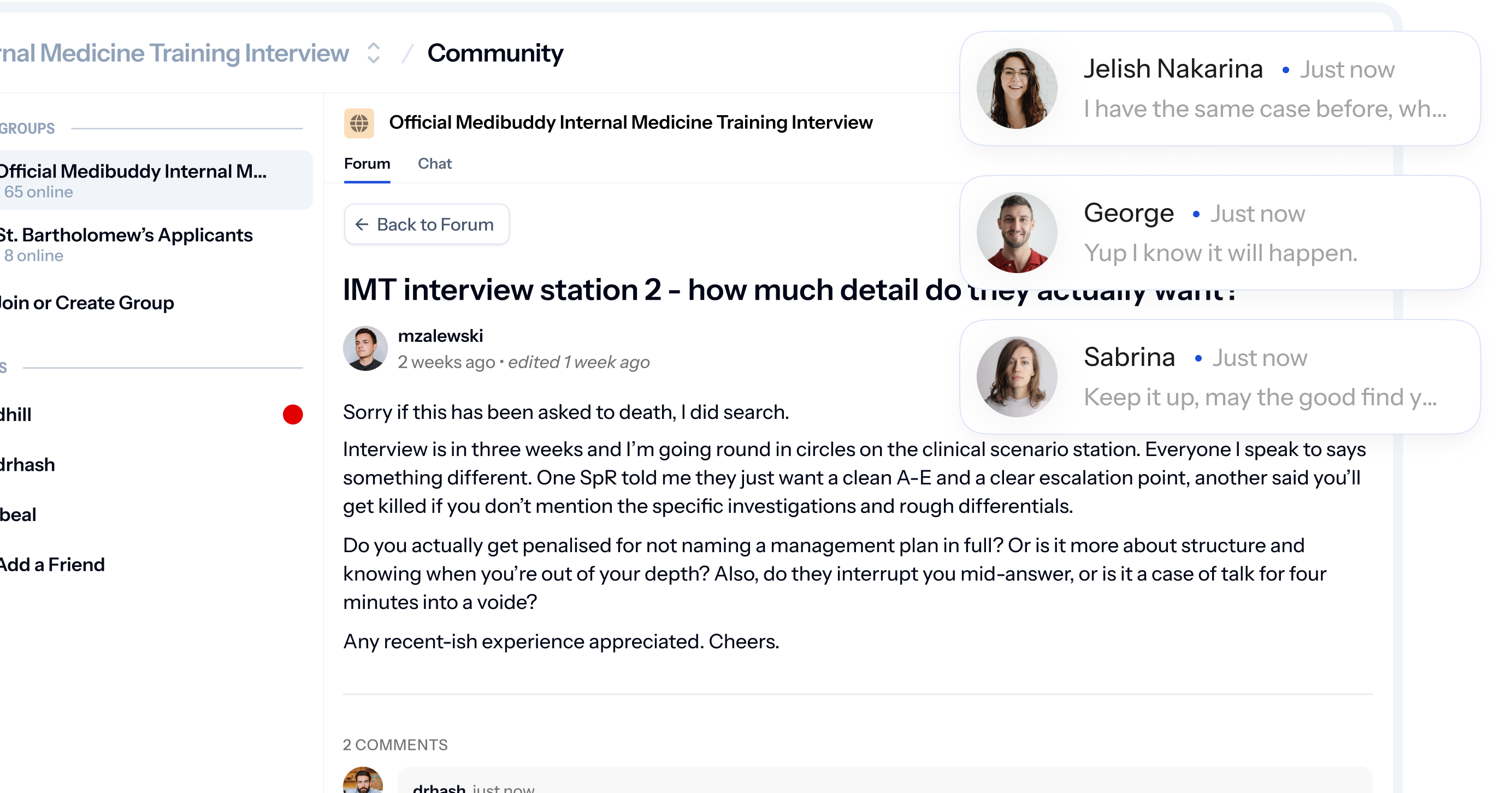
When you prepare in isolation, you're relying on your own interpretation of the interview process, which is one of the quickest ways to get found out on the day. Study Groups connect you with other doctors across the country who are also applying to Histopathology HST, so you can engage and network with people preparing for the same interview as you. Everyone brings different experience from different hospitals, meaning you won't ever miss out on the key bits of information that could swing the interview in your favour.
Live MocksBeta
Candidates who don't take part in mocks often struggle to adapt to the pressure of the interview. Your knowledge might be correct, but without convincing delivery the interviewers will score you poorly. The best way to improve your delivery is to take part in as many live mocks as possible, which is why we haven't put a cap on how many you can do. We also know how difficult it can be to organise mocks with other people, so all you have to do is join the waiting room and we'll match you with a different Histopathology HST candidate each time. Take turns as both the interviewer and candidate on real Question Bank scenarios, so you can see exactly how other candidates perform in real time, while refining your own interview technique.
Peer FeedbackBeta
Preparing alone means you won't know how you're coming across during the interview. And preparing with the same few candidates means you'll miss opportunities to improve, which is why it's so important to get as many opinions as possible on your performance. With Medibuddy, you can record a mock and submit it for feedback from other candidates on the platform, so you receive a wider range of feedback and refine your answers with each person you practise with. Reviewing other people's mocks is just as valuable, as it shows you how strong candidates handle the same scenarios, which is one of the fastest ways to improve.
The interview

What to expect from the Histopathology HST interview

Higher Specialist Training in Histopathology is run by the RCPI Faculty of Pathology, with entry at first-year Specialist Registrar level. There is no CV shortlisting score for this specialty: the Faculty's aptitude assessment in BST year 2 is used in lieu of shortlisting. The 2027 interview is held in person on 5 February 2027, and it is scored out of 100 across five published categories.

Category

BST Performance

30 of the 100 marks, joint largest. RCPI doesn't define this category further; the older criteria called it Career to Date in Pathology, covering histopathology and cytopathology, autopsy and molecular pathology. The Faculty's aptitude assessment in BST year 2 already gives a view of your BST, so be ready to discuss your training in depth and to reason clearly through diagnostic questions.
Category

Research & Audit

10 marks. Be ready to talk through your audits, QI projects, publications and presentations: what you did, what you found and what changed as a result.
Category

Management & Leadership

10 marks. RCPI's aptitude criteria cite rostering, training, hospital committee and laboratory membership, and awareness of laboratory quality assurance, so show real leadership and an understanding of how a laboratory stays safe and accredited.
Category

General Suitability

30 of the 100 marks, joint largest. RCPI doesn't define this category further. Show your motivation for histopathology, your career goals within the HSE, your insight into the HST programme and its exams, and sound professional judgement.
Category

Presentation / Communication

20 marks. RCPI doesn't say whether this involves a prepared presentation, so prepare to communicate findings clearly and concisely to clinicians, colleagues and families.

How the interview is scored

RCPI publishes the full marking scheme for the interview, out of 100: BST Performance 30, Research & Audit 10, Management & Leadership 10, General Suitability 30 and Presentation / Communication 20. The number of stations, their length and whether slides or cases are shown are not published. Our model answers are structured against each category, so you know exactly what a strong, well-organised answer looks like across all five.
Get ready

How to prepare for the Histopathology HST interview

Start with the Question Bank

Work through 96 scenarios across all five scored categories, each with a model answer. Start by reading how a strong answer is formed, then think about how you'd deliver it.

Talk the hard ones through in Study Groups

Study Groups are your biggest opportunity to network and connect with other candidates sitting the same interview as you. Everyone on the platform is in the same boat, so don't be scared to get involved and ask questions. Someone in your study group might just help you work through a scenario you've been struggling with.

Rehearse out loud in Live Mocks

Live mocks are where you begin to put everything you've learned into practice, and we know from experience that those who practise with a wide range of candidates usually do the best. Organise mocks with people from one of your study groups, or get matched with a random Histopathology HST candidate, then take turns as interviewer and candidate using real scenarios until answering out loud under pressure feels normal.

Get reviewed with Peer Feedback before the day

Once you've recorded a mock, you can have other community members review it. This lets you see how you come across to other people, and gives you time to refine your delivery as you revise, rather than being caught out on the day. Reviewing other people's mocks is just as crucial, as you see how other candidates navigate the same scenarios.
Questions

Frequently asked questions

What does the Histopathology HST interview involve?
An in-person interview on 5 February 2027, scored out of 100 across five published categories: BST Performance (30), Research & Audit (10), Management & Leadership (10), General Suitability (30) and Presentation / Communication (20). There is no CV shortlisting score; the Faculty of Pathology's aptitude assessment in BST year 2 is used instead. Our scenarios and model answers cover each category so you know how to structure a strong response.
How competitive is the Histopathology HST interview?
Competitive. RCPI hasn't published the number of Histopathology HST posts for 2027. BST Performance and General Suitability carry 60 of the 100 interview marks between them, but every category counts, which is why a structured, well-rehearsed approach across all five matters.
Who writes the model answers?
Written by our team of medical writers and reviewed against the current selection criteria and Irish guidance, so every answer reflects how the Histopathology HST interview is scored now.
Can I practise with other candidates?
Yes. Every Revision Platform purchase gives you the opportunity to connect with other candidates through Study Groups, Live Mocks and Peer Feedback.
How do the Live Mocks work?
All you have to do is join the waiting room, and we match you with another Histopathology HST candidate. You then take turns as interviewer and candidate on real Question Bank scenarios, so you gain experience answering out loud to a real person before you ever sit in front of the panel.
What are Study Groups and how do they help?
Study Groups are community forums for doctors across the country preparing for the same Histopathology HST interview. You can ask questions, share what you're struggling with, and compare how you'd approach a scenario.
Can I get feedback on my interview performance?
Yes. After you've recorded a mock, you can ask other members to review it, so you can see which part of your answer needs fine-tuning.
How long do I get access for?
Access runs for 12 months from the purchase date.

Start preparing for the Histopathology HST interview

The Revision Platform gives you 96 scenarios and over 400 model-answered questions to practise and refine with other candidates through Study Groups, Live Mocks and Peer Feedback.

Histopathology HST Revision Platform • €170

Buy Now