Obs and Gynae HST Interview Question Bank – Medibuddy Ireland
Obstetrics and Gynaecology HST • 2027 Interview

The 2027 Obstetrics and Gynaecology HST Interview Revision Platform: Question Bank, Live Practice and Mocks with Other Candidates

The Medibuddy Obstetrics and Gynaecology HST Question Bank includes 61 scenarios and over 235 model-answered questions that closely mirror the real interview, each written and edited by high-scoring candidates who sat the Obstetrics and Gynaecology HST interview in 2026.

However, knowing a strong answer isn't the same as delivering it well under pressure, which is why we provide:

10 years' experience preparing doctors for interviews

Users of the Medibuddy Obstetrics and Gynaecology HST Revision Platform have secured some of the most competitive training posts in recent rounds. Ask around, there's a good chance the trainees in the year above you used us too.

Always up to date

Did you know the interviews change every year? That's why we review and update every Question Bank on the platform twice a year, so you know you're always practising with scenarios based on the latest interview structure.

Network and practise real interview scenarios with other candidates

Question Bank

See every scenario, and how to answer it well

61 scenarios across all five scored categories, which tell you exactly how to respond to each question.
Study Groups

Connect with candidates across the country
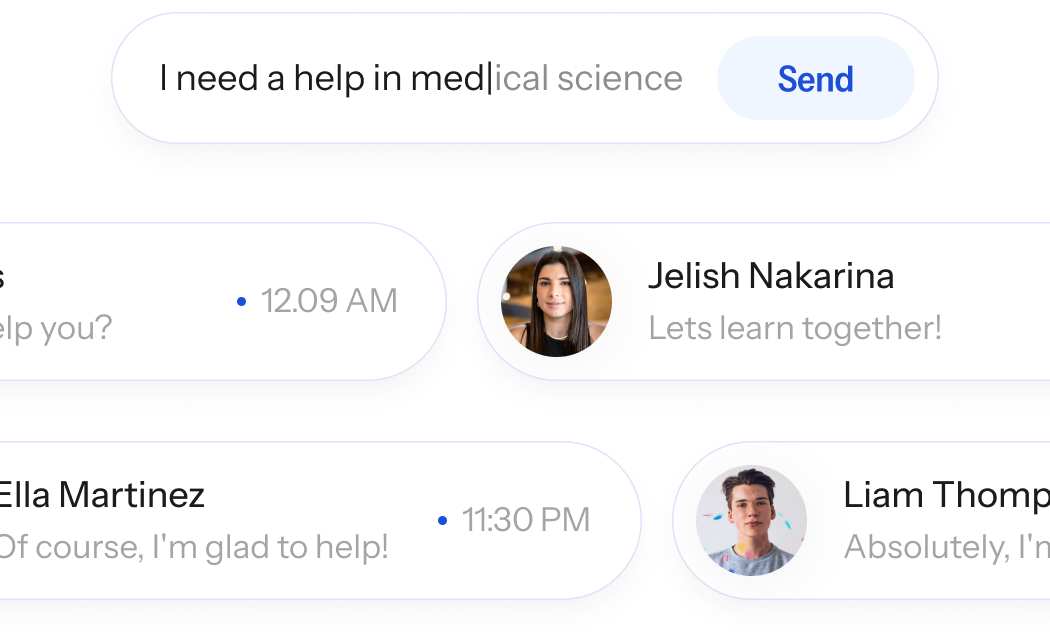
Most people only ever practise with one or two friends. Study Groups connect you with candidates right across the country sitting the same Obstetrics and Gynaecology HST interview.
Live MocksBeta

Practise interview technique with different candidates

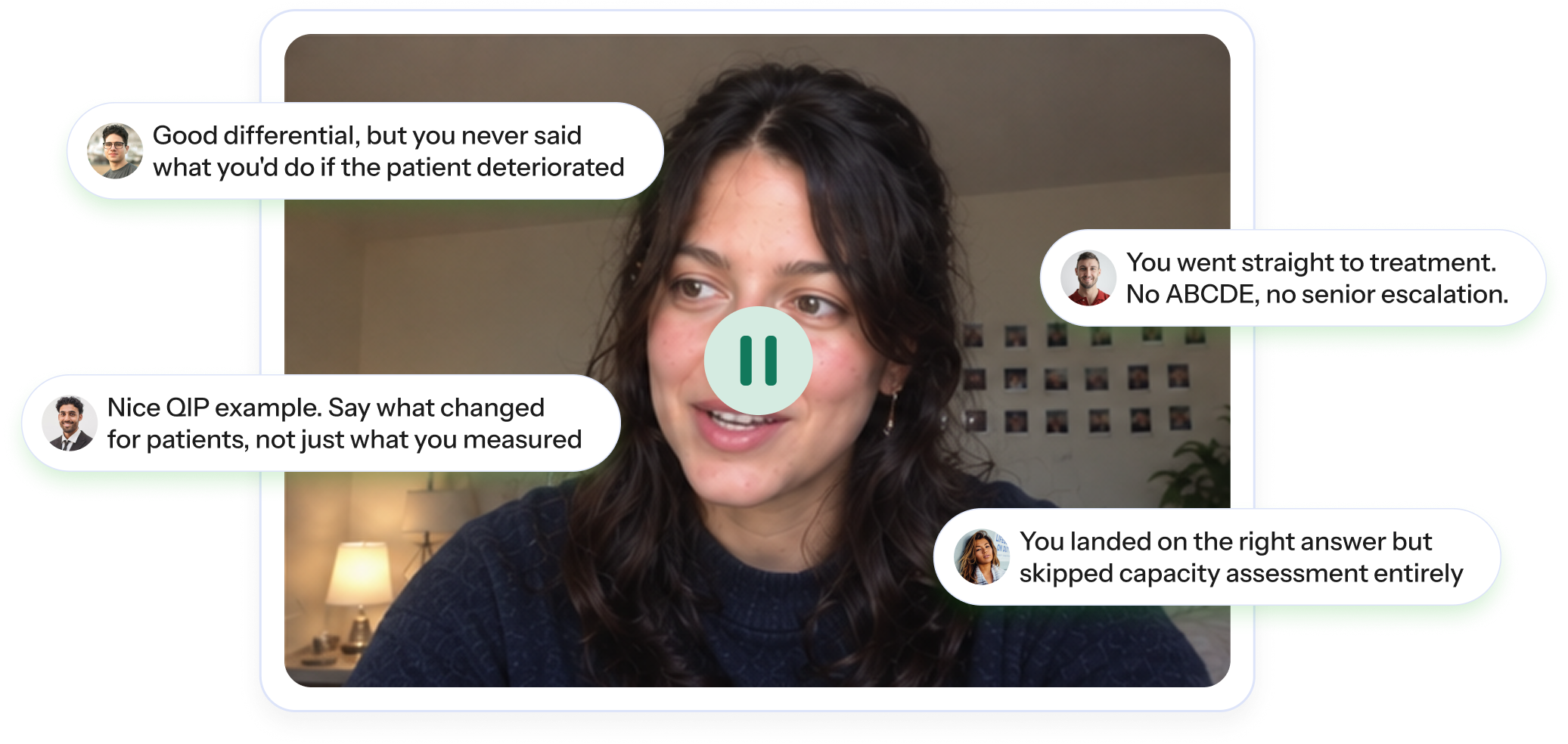
Arrange or get matched on demand with other candidates and run real scenarios out loud under interview conditions. Those who practise with the widest range of people tend to score the highest.
Peer FeedbackBeta

Reviewed by candidates across the platform

Submit your recorded mocks to candidates across the platform and get honest, varied feedback. Reviewing other people's mocks teaches you just as much.

The question bank, and other candidates to practise with, all in one platform.

Obstetrics and Gynaecology HST Revision Platform • €170

Gain access to 61 scenarios across all five scored categories, and collaborate with other candidates through Study Groups, Live Mocks and Peer Feedback.
Get instant access
What candidates say

Scored well, secured their post

A few of the candidates who prepared with us for the Obstetrics and Gynaecology HST interview.

Verified candidateInterviewed 2026
"Having a clear structure for the clinical question and management categories meant I stayed calm and systematic under pressure."
Secured HST post
Verified candidateInterviewed 2026
"Practising the personal specification and professionalism questions out loud with other candidates was the single most useful thing I did before the day."
Ranked highly
Part 1 • See the questions

The Medibuddy 2027 Obstetrics and Gynaecology HST Question Bank

The interview follows five scored categories, and each part is tightly timed, so you have a limited window to deliver the high-scoring answers you need to do well. That means every point has to land, and knowing how to structure each answer is essential. That's why each of our 61 scenarios comes with a model answer, written by candidates who scored highly in the 2026 Obstetrics and Gynaecology HST interview, so you know exactly how to approach every question the panel puts to you.
What's inside

What's included in the Obstetrics and Gynaecology HST Question Bank

There's nothing worse than reaching the interview and being handed a question you've never prepared for. The panel scores five categories, from your portfolio and research to a clinical question, management and professionalism, so the safest approach is to revise across all of them. We provide scenarios for every category, including the common themes and the trickier cases that have come up before, so you don't get caught out.

CV (Career to Date)

Questions on your training, achievements and career narrative, with model answers that show how to present your CV clearly.

Research, Audit & Teaching

Research, audit and teaching questions, with worked answers that evidence your contribution and its impact.

Clinical Question

Obstetric and gynaecological emergencies and management, from postpartum haemorrhage to pre-eclampsia and the acute gynaecology take, each with a worked answer.

Management & Strategy

Running the labour ward, transfers and safe handover, with structured answers that show sound judgement under pressure.

Personal Specification, Professionalism & Interview Performance

Professional, ethical and communication scenarios, from consent and capacity to interview technique, with structured model answers.
Built around the five scored categories
Delivered by the Institute of Obstetricians and Gynaecologists. Every scenario is anchored to Irish practice, guidelines and law, with model answers structured against the scoring categories.
Try it

Try an example Obstetrics and Gynaecology HST question

You are the first-year Specialist Registrar on call for the labour ward, with the consultant at home. The midwife calls you urgently to a 28-year-old, para 2, who had a normal vaginal birth at 40+1 weeks 25 minutes ago. Active management of the third stage was given and the placenta delivered complete. She is now bleeding heavily, with an estimated 1,600 mL lost and ongoing. Her BP is 84/54, pulse 128, respiratory rate 22, and she is pale, clammy and anxious.

How do you immediately assess and resuscitate her?

Question
How do you immediately assess and resuscitate this woman?
Example answer
This is a major postpartum haemorrhage with shock, so I would activate the major haemorrhage protocol and run resuscitation and cause-finding in parallel.
  • Call for help: the labour ward emergency call for a second midwife, the on-call anaesthetist and blood bank, telephone the consultant to attend, and designate someone to record timings and blood loss.
  • Resuscitate: high-flow oxygen, lie her flat and keep her warm; two large-bore cannulae with bloods including FBC, coagulation with Clauss fibrinogen, crossmatch and point-of-care haemoglobin and lactate; limit warmed crystalloid to around 2 L as a bridge and start O-negative or group-specific blood as soon as available; catheterise and monitor closely.
  • Cause: a bimanual examination and systematic assessment of the four Ts, tone, trauma, tissue and thrombin.
Question
The uterus is soft and poorly contracted with no visible trauma. What is your stepwise medical management?
Example answer
Uterine atony is the cause, so I would treat it immediately while resuscitation continues.
  • Mechanical: uterine massage and bimanual compression, and ensure the bladder is empty.
  • Uterotonics in sequence: oxytocin as a slow bolus then an infusion, ergometrine (avoided if hypertensive), carboprost (avoided in severe asthma), and misoprostol if others are contraindicated or fail.
  • Antifibrinolytic: tranexamic acid 1 g IV within three hours, repeated after 30 minutes if bleeding persists, per the NWIHP and IOG guideline.
  • If bleeding does not settle promptly, move to theatre without delay rather than exhausting medical measures.
Question
Blood loss is now 2,200 mL with Hb 58, lactate 4.8 and Clauss fibrinogen 1.0. How does this change your management?
Example answer
These show severe haemorrhagic shock with a critically low fibrinogen indicating consumptive coagulopathy, which will worsen bleeding unless corrected urgently.
  • Blood products: run the major haemorrhage protocol with red cells and FFP until results return, then guided by results, ROTEM and haematology; give fibrinogen concentrate or cryoprecipitate now, aiming above 2 g/L, and repeat bloods every 30 minutes.
  • Perfusion: the lactate of 4.8 reflects hypoperfusion, so resuscitate with blood products rather than more crystalloid, correct ionised hypocalcaemia and keep her warm.
  • Escalation: the consultant on site now, an arterial line, and an HDU or ICU bed requested.
Question
Despite uterotonics and tranexamic acid bleeding continues to 2,800 mL. You are in theatre with the consultant. What surgical options do you have?
Example answer
With refractory atony the priority is surgical haemostasis, working from least to most invasive.
  • An examination under anaesthesia to exclude trauma or retained tissue.
  • Intrauterine balloon tamponade with a Bakri balloon and the tamponade test.
  • Compression sutures at laparotomy, a B-Lynch first, with alternatives such as Hayman or Cho.
  • Vascular ligation, bilateral uterine artery then internal iliac, led by the consultant.
  • Uterine artery embolisation if she is stable and the service is available.
  • Peripartum hysterectomy without further delay if other measures fail, decided early with the consultant rather than at peri-arrest.
Question
Haemostasis is achieved with a B-Lynch suture and she goes to HDU. How do you manage her over the next 24 hours?
Example answer
The priorities are monitoring for rebleeding, correcting residual abnormalities, preventing organ complications and planning recovery.
  • Monitoring: continuous HDU monitoring with hourly urine output, repeat bloods, and ongoing checks of vaginal loss and uterine tone.
  • Rebleeding: continue the oxytocin infusion for at least four hours with a low threshold to return to theatre.
  • Surveillance: for acute kidney injury, transfusion complications and, later, Sheehan's syndrome.
  • Recovery: mechanical VTE prophylaxis from admission with low-molecular-weight heparin once bleeding has settled, and anaemia management with iron.
Question
Which antenatal and intrapartum risk factors for PPH would you identify, and how would you plan care for a high-risk woman?
Example answer
Risk should be stratified at booking, reviewed antenatally and reassessed in labour, remembering many cases occur with no risk factors.
  • Risk factors: previous PPH or uterine surgery, placenta praevia or accreta, multiple pregnancy, polyhydramnios or macrosomia, antepartum haemorrhage, pre-eclampsia or anaemia, obesity, a bleeding disorder or anticoagulation, and prolonged, induced or operative labour.
  • High-risk planning: optimise haemoglobin antenatally, plan birth in a unit with on-site blood bank and anaesthetic and haematology support, group and screen with IV access on admission, active third-stage management for all births, and a clear documented individualised PPH plan per the NWIHP and IOG guideline.

That's one scenario. There are 60 more.

Obstetrics and Gynaecology HST Revision Platform • €170

Includes every scenario in the Question Bank, and access to Study Groups, Live Mocks with other candidates and Peer Feedback.
Get instant access
Actively maintained

How we keep our Question Banks up to date

The Obstetrics and Gynaecology HST interview changes from year to year, and the biggest fear for any candidate is getting to interview day and realising you've revised with a question bank that's totally outdated.

That's why we review and update every Question Bank twice a year, so you know you're revising with scenarios that are likely to come up. We do this in April after the previous year's interviews, and again in the autumn when the new recruitment guidance is published.

For 2027, this process kept the Question Bank aligned with the current five-category format, across CV, research and teaching, the clinical question, management and strategy, and personal specification and professionalism, so you always practise with the format the panel is using now.
Updated for 2027 Interviews
Part 2 • Practise them live

The only interview resource where you can practise live with other candidates from across the country

Our Obstetrics and Gynaecology HST Question Bank tells you exactly how to answer real interview scenarios. But how you practise with them will determine how many marks you score. Simply reading answers off a screen won't prepare you for the intense scrutiny you'll face in the interview, and only practising with the same few colleagues limits the feedback you'll get. Medibuddy gives you unique access to Obstetrics and Gynaecology HST candidates across the country, so you can learn from a variety of perspectives and hear a far wider range of feedback than your own circle could ever give you.
Study Groups
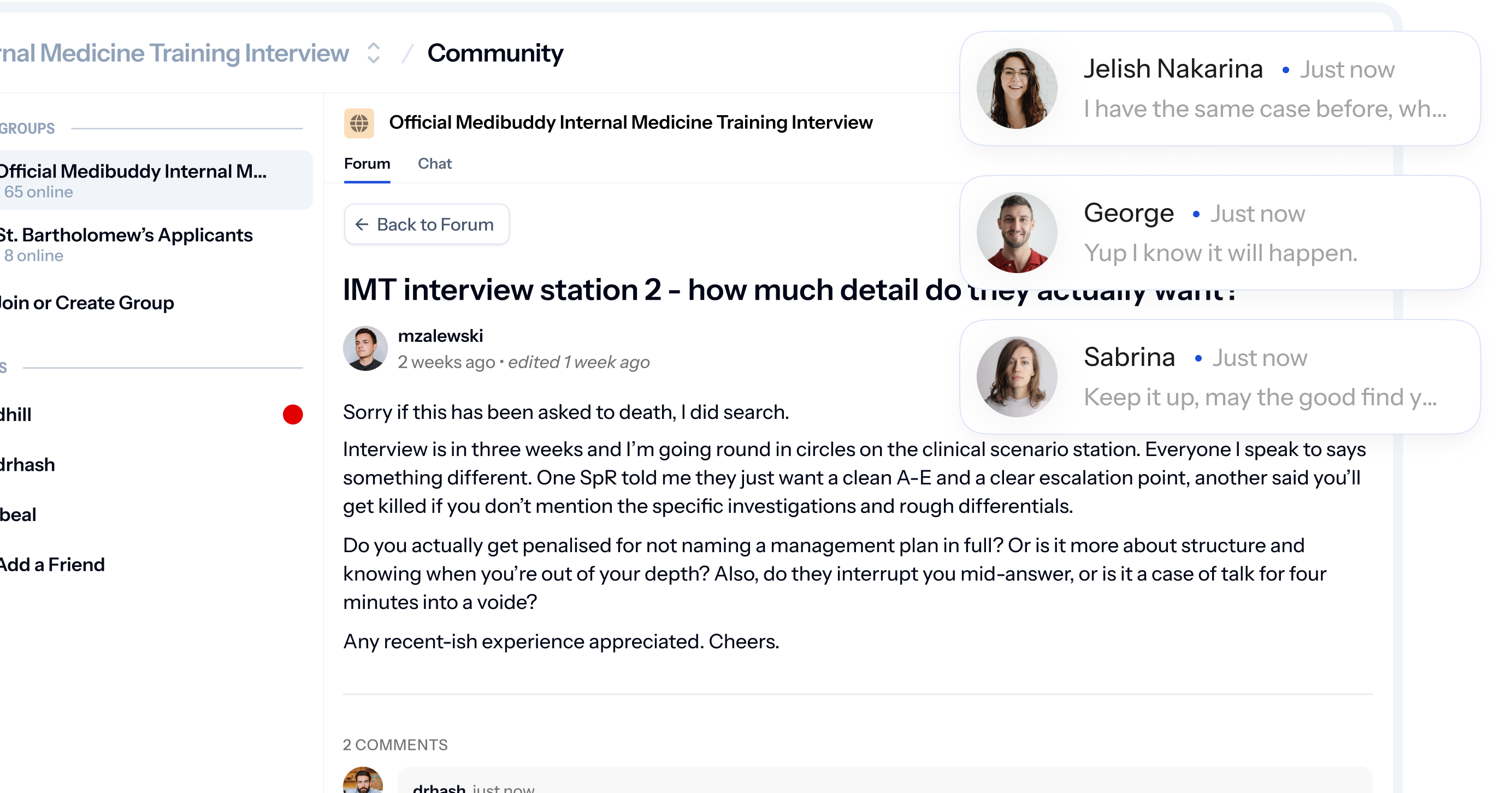
When you prepare in isolation, you're relying on your own interpretation of the interview process, which is one of the quickest ways to get found out on the day. Study Groups connect you with other doctors across the country who are also applying to Obstetrics and Gynaecology HST, so you can engage and network with people preparing for the same interview as you. Everyone brings different experience from different units, meaning you won't miss out on the key bits of information that could swing the interview in your favour.
Live MocksBeta
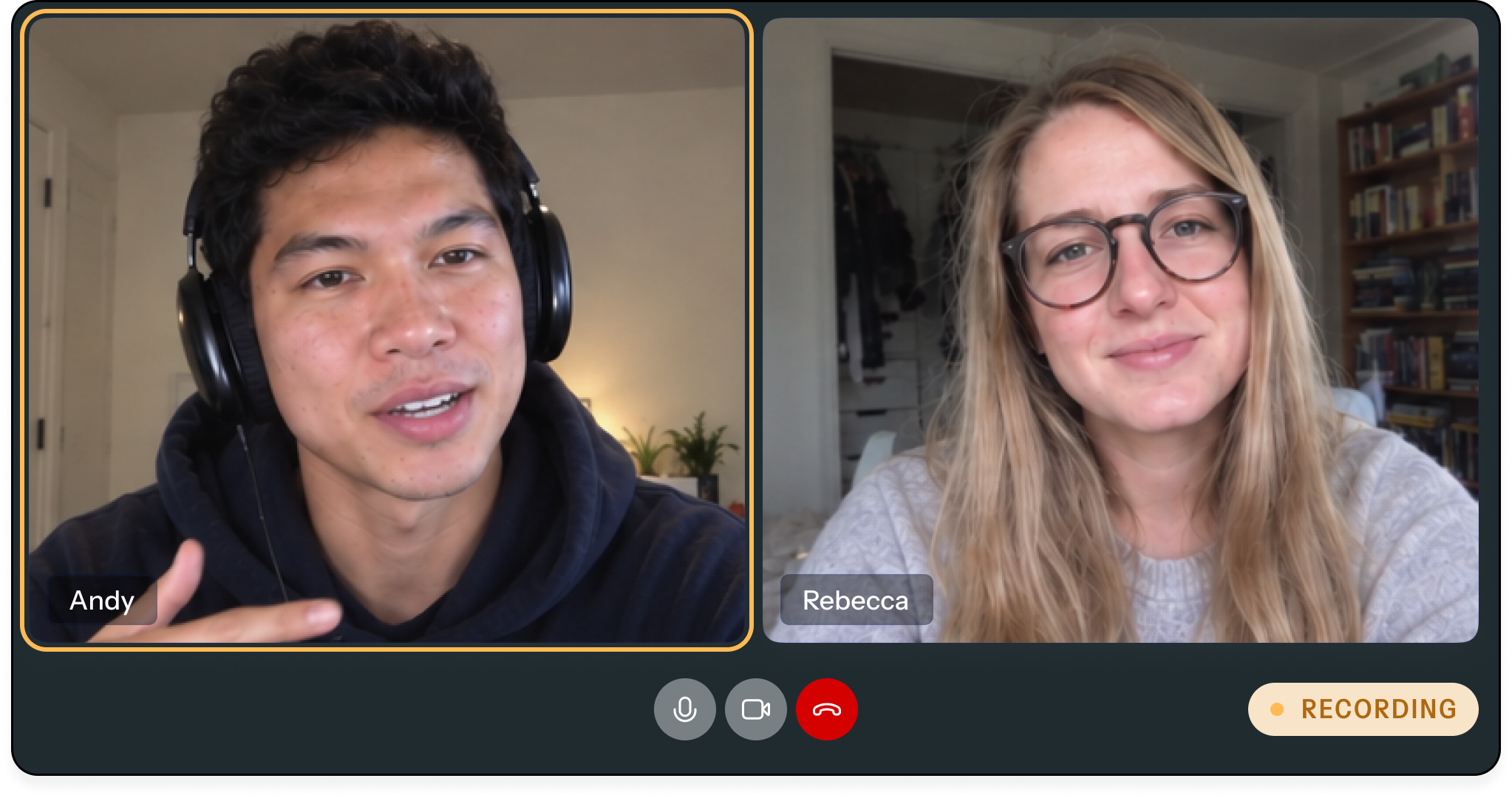
Candidates who don't take part in mocks often struggle to adapt to the pressure of the interview. Your knowledge might be correct, but without convincing delivery the interviewers will score you poorly. The best way to improve your delivery is to take part in as many live mocks as possible, which is why we haven't put a cap on how many you can do. All you have to do is join the waiting room and we'll match you with a different Obstetrics and Gynaecology HST candidate each time. Take turns as both the interviewer and candidate on real Question Bank scenarios, so you can see exactly how other candidates perform in real time while refining your own technique.
Peer FeedbackBeta
Preparing alone means you won't know how you're coming across during the interview, and preparing with the same few candidates means you'll miss opportunities to improve, which is why it's so important to get as many opinions as possible on your performance. With Medibuddy, you can record a mock and submit it for feedback from other candidates on the platform, so you receive a wider range of feedback and refine your answers with each person you practise with. Reviewing other people's mocks is just as valuable, as it shows you how strong candidates handle the same scenarios.
The interview

What to expect from the Obstetrics and Gynaecology HST interview

Higher Specialist Training in Obstetrics and Gynaecology with the Royal College of Physicians of Ireland, delivered by the Institute of Obstetricians and Gynaecologists, is highly competitive, and strong applicants are often separated by narrow margins at interview.

The interview follows five scored categories: your CV and career to date, research, audit and teaching, a clinical question, management and strategy, and personal specification, professionalism and interview performance.

Category

CV (Career to Date)

Your training, achievements and career narrative, and how you present them clearly and link them to what the panel is looking for.
Category

Research, Audit and Teaching

Your research, audit and teaching experience, and how you evidence your contribution and its impact.
Category

Clinical Question

An obstetric or gynaecological scenario, assessing your clinical judgement and safe, structured management.
Category

Management and Strategy

Running the labour ward, organising transfers and making handover safe, with sound judgement under pressure.
Category

Personal Specification, Professionalism and Interview Performance

Professional, ethical and communication situations, handled with judgement, composure and integrity.

How the interview is scored

The interview follows five scored categories. Our model answers are structured against those categories, so you know what a strong, well-organised answer looks like in each.
Get ready

How to prepare for the Obstetrics and Gynaecology HST interview

Start with the Question Bank

Work through 61 scenarios across all five categories, each with a worked answer from a candidate who scored well in the 2026 interview. Start by reading how a strong answer is formed, then think about how you'd deliver it.

Talk the hard ones through in Study Groups

Study Groups are your biggest opportunity to network and connect with other candidates sitting the same interview as you. Everyone on the platform is in the same boat, so don't be scared to get involved and ask questions. Someone in your study group might just help you work through a scenario you've been struggling with.

Rehearse out loud in Live Mocks

Live mocks are where you begin to put everything you've learned into practice, and we know from experience that those who practise with a wide range of candidates usually do the best. Organise mocks with people from one of your study groups, or get matched with a random Obstetrics and Gynaecology HST candidate, then take turns as interviewer and candidate using real scenarios until answering out loud under pressure feels normal.

Get reviewed with Peer Feedback before the day

Once you've recorded a mock, you can have other community members review it. This lets you see how you come across to other people, and gives you time to refine your delivery as you revise, rather than being caught out on the day. Reviewing other people's mocks is just as crucial, as you see how other candidates navigate the same scenarios.
Questions

Frequently asked questions

What does the Obstetrics and Gynaecology HST interview involve?
It is Higher Specialist Training in Obstetrics and Gynaecology with the Royal College of Physicians of Ireland, delivered by the Institute of Obstetricians and Gynaecologists, scored across five categories: CV (career to date), research, audit and teaching, a clinical question, management and strategy, and personal specification, professionalism and interview performance.
How competitive is the Obstetrics and Gynaecology HST interview?
Obstetrics and Gynaecology is a competitive HST specialty, and strong candidates are frequently separated by small margins at interview, which is why a structured, well-rehearsed approach matters.
Who writes the model answers?
High-scoring candidates who sat the Obstetrics and Gynaecology HST interview in 2026, so the answers reflect what came up and what scored this year.
Can I practise with other candidates?
Yes. Every Revision Platform purchase gives you the opportunity to connect with other candidates through Study Groups, Live Mocks and Peer Feedback.
How do the Live Mocks work?
All you have to do is join the waiting room, and we match you with another Obstetrics and Gynaecology HST candidate. You then take turns as interviewer and candidate on real Question Bank scenarios, so you gain experience answering out loud to a real person before you ever sit in front of the panel.
What are Study Groups and how do they help?
Study Groups are community forums for doctors across the country preparing for the same Obstetrics and Gynaecology HST interview. You can ask questions, share what you're struggling with, and compare how you'd approach a scenario.
Can I get feedback on my interview performance?
Yes. After you've recorded a mock, you can ask other members to review it, so you can see which part of your answer needs fine-tuning.
How do you keep the Obstetrics and Gynaecology HST Question Bank up to date?
We review and update it twice a year: in April after that year's interviews, and again in the autumn when the new recruitment guidance is published, so you always practise with the current five-category format.
How long do I get access for?
Access runs for 12 months from the purchase date.

Start preparing for the Obstetrics and Gynaecology HST interview

The Revision Platform gives you 61 scenarios to practise and refine with other candidates through Study Groups, Live Mocks and Peer Feedback. Ten years preparing doctors for interviews, with the questions, this year's model answers and live practice, all in one place.

Obstetrics and Gynaecology HST Revision Platform • €170

Buy Now