Respiratory Medicine and GIM HST Interview Question Bank – Medibuddy Ireland
Respiratory Medicine and GIM HST • 2027 Interview

The 2027 Respiratory Medicine and GIM HST Interview Revision Platform: Question Bank, Live Practice and Mocks with Other Candidates

The Medibuddy Respiratory Medicine and GIM HST Question Bank includes 72 scenarios and over 250 model-answered questions that closely mirror the real interview, each written and edited by high-scoring candidates who sat the Respiratory Medicine and GIM HST interview in 2026.

However, knowing a strong answer isn't the same as delivering it well under pressure, which is why we provide:

10 years' experience preparing doctors for interviews

Users of the Medibuddy Respiratory Medicine and GIM HST Revision Platform have secured some of the most competitive training posts in recent rounds. Ask around, there's a good chance the trainees in the year above you used us too.

Always up to date

Did you know the interviews change every year? That's why we review and update every Question Bank on the platform twice a year, so you know you're always practising with scenarios based on the latest interview structure.

Network and practise real interview scenarios with other candidates

Question Bank

See every scenario, and how to answer it well

72 scenarios across all five scored categories, which tell you exactly how to respond to each question.
Study Groups

Connect with candidates across the country
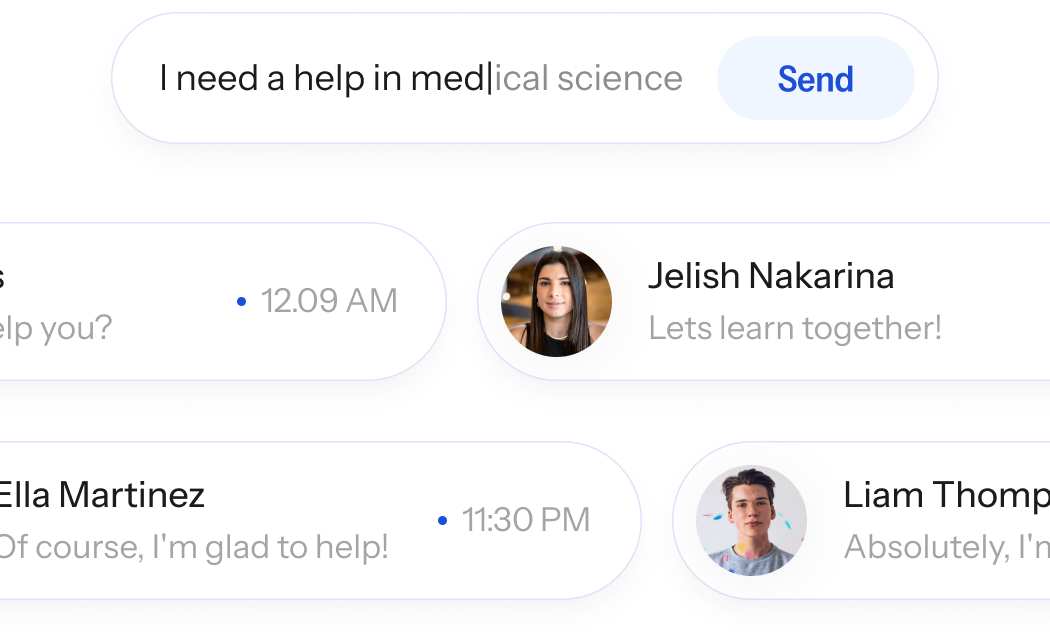
Most people only ever practise with one or two friends. Study Groups connect you with candidates right across the country sitting the same Respiratory Medicine and GIM HST interview.
Live MocksBeta

Practise interview technique with different candidates

Arrange or get matched on demand with other candidates and run real scenarios out loud under interview conditions. Those who practise with the widest range of people tend to score the highest.
Peer FeedbackBeta

Reviewed by candidates across the platform

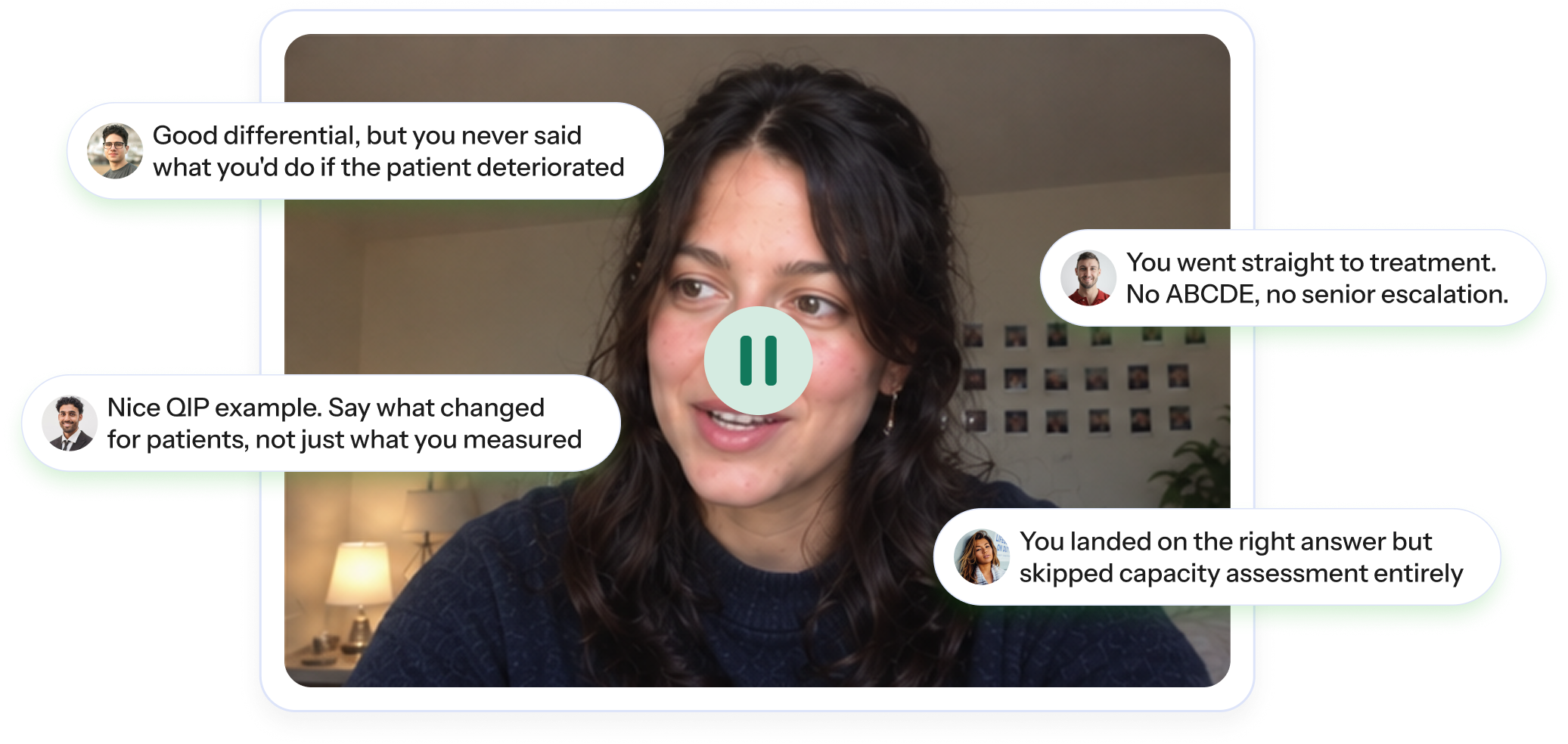
Submit your recorded mocks to candidates across the platform and get honest, varied feedback. Reviewing other people's mocks teaches you just as much.

The question bank, and other candidates to practise with, all in one platform.

Respiratory Medicine and GIM HST Revision Platform • €170

Gain access to 72 scenarios across all five scored categories, and collaborate with other candidates through Study Groups, Live Mocks and Peer Feedback.
Get instant access
What candidates say

Scored well, secured their post

A few of the candidates who prepared with us for the Respiratory Medicine and GIM HST interview.

Verified candidateInterviewed 2026
"Being ready across the CV, specialty knowledge and research questions as well as the acute GIM scenarios meant nothing caught me off guard on the day."
Secured HST post
Verified candidateInterviewed 2026
"Practising the career-progression and professionalism questions out loud with other candidates was the single most useful thing I did before the day."
Ranked highly
Part 1 • See the questions

The Medibuddy 2027 Respiratory Medicine and GIM HST Question Bank

This is a dual Respiratory Medicine and GIM selection scored across five categories, and each part is tightly timed, so you have a limited window to deliver the high-scoring answers you need to do well. That means every point has to land, and knowing how to structure each answer is essential. That's why each of our 72 scenarios comes with a model answer, written by candidates who scored highly in the 2026 Respiratory Medicine and GIM HST interview, so you know exactly how to approach every question the panel puts to you.
What's inside

What's included in the Respiratory Medicine and GIM HST Question Bank

There's nothing worse than reaching the interview and being handed a question you've never prepared for. The panel scores five categories, spanning your portfolio, your specialty knowledge and your clinical GIM judgement, so the safest approach is to revise across all of them. We provide scenarios for every category, including the common themes and the trickier cases that have come up before, so you don't get caught out.

CV

Questions on your training, achievements and career narrative, with model answers that show how to present your CV clearly and link it to what the panel is looking for.

Career Progression, Professionalism & Interview Performance

Professionalism, career-planning and interview-technique scenarios, with model answers that show composure and sound judgement under pressure.

Knowledge & Experience of the Specialty

Respiratory medicine from bronchiectasis and TB to the breadth of the specialty, with structured answers so you can discuss it with confidence and depth.

Research, Audit, Teaching & Management

Research, audit, teaching and management questions, with worked answers that show how to evidence your contribution and its impact.

General Internal Medicine

Acute GIM scenarios where you play the registrar: assess, resuscitate and manage safely, each with a worked answer.
Built around the five scored categories
The bank serves both halves of this dual programme. Every scenario is anchored to Irish practice, guidelines and law, with model answers structured against the RCPI selection criteria.
Try it

Try an example Respiratory Medicine and GIM HST question

You are the Specialist Registrar on the acute medical take in a model 4 hospital. You are called to review a 72-year-old woman with known severe COPD (on home nebulisers and LAMA/LABA/ICS) admitted two hours ago with an infective exacerbation. Despite controlled oxygen at 28%, salbutamol and ipratropium nebulisers and oral prednisolone, she remains breathless and distressed. Observations: SpO2 84%, RR 30, HR 110, BP 140/86, GCS 14 (confused). Repeat ABG on 28% oxygen: pH 7.28, PaCO2 9.6 kPa, PaO2 6.8 kPa, HCO3 33 mmol/L.

Interpret this ABG and tell us what it means for this patient.

Question
Interpret this ABG and explain what it tells you about this patient's condition.
Example answer
This ABG shows acute-on-chronic hypercapnic (type 2) respiratory failure with a decompensated respiratory acidosis, consistent with a severe COPD exacerbation that has not responded to initial treatment.
  • pH 7.28: a significant acidosis, below the 7.35 threshold that defines the respiratory acidosis requiring escalation under NCEC NCG No. 27.
  • PaCO2 9.6 kPa: markedly raised, indicating alveolar hypoventilation and CO2 retention.
  • HCO3 33 mmol/L: raised, confirming chronic metabolic compensation from long-standing CO2 retention.
  • PaO2 6.8 kPa: hypoxaemic despite 28% oxygen, from ventilation-perfusion mismatch.
The acute fall in pH despite a high bicarbonate means she is decompensating, and her confusion fits hypercapnic encephalopathy. With persisting tachypnoea and failure of initial therapy, she meets the criteria for non-invasive ventilation: a pH below 7.35 and PaCO2 above 6.0 after controlled oxygen and medical treatment.
Question
What is your immediate management priority now?
Example answer
The immediate priority is to start non-invasive ventilation without delay while optimising medical therapy and escalating.
  • NIV (BiPAP): start promptly at the bedside, with settings around IPAP 12 to 16 and EPAP 4 to 5, FiO2 titrated to SpO2 88 to 92%; nurse her at 45 degrees with a well-fitting mask, and repeat the ABG at 60 minutes.
  • Medical therapy: back-to-back air-driven salbutamol and ipratropium nebulisers to avoid excess oxygen, IV hydrocortisone if she cannot safely swallow on NIV, and antibiotics per the local antibiogram for an infective exacerbation while awaiting sputum.
  • Escalation: contact my consultant immediately and document it, and call the ICU or HDU team now to co-assess and agree a ceiling in case NIV fails, rather than waiting for the one-hour ABG.
Question
Before starting NIV, how do you approach the conversation about escalation and ceilings of care?
Example answer
Agreeing a ceiling of care before starting NIV is essential, not optional, and must involve my consultant and, where possible, the patient and family, clearly documented.
  • Capacity: although her GCS is 14, capacity is decision- and time-specific under the Assisted Decision-Making (Capacity) Act 2015; if she can understand, retain, weigh and communicate a decision, a refusal must be respected. I would ask whether she understands what NIV involves and whether she has an advance healthcare directive.
  • Appropriateness: consider her functional status, disease severity and likely benefit from intubation if NIV fails, and discuss with my consultant whether ICU and invasive ventilation would benefit her and fit her wishes.
  • Communication: speak to her first if she has capacity, explaining NIV as a mask to help her breathe; if she lacks capacity, contact next of kin for known wishes or a directive, and document the capacity assessment, reasoning, consultant discussion and agreed ceiling before starting.
Question
One hour into NIV the repeat ABG shows pH 7.32, PaCO2 8.8 kPa and she is more alert. How do you interpret this and what next?
Example answer
This is a partial but meaningful response: the pH has risen to 7.32, the PaCO2 is falling and she is more alert, which supports continuing NIV, though she is still acidotic and not yet safe.
  • An improving pH and PaCO2 with clinical improvement at one to two hours predicts NIV success, and reversing encephalopathy is a good prognostic sign.
  • Continue NIV at current settings without reducing IPAP prematurely, reassess work of breathing, mask tolerance and haemodynamics, and repeat the ABG at 90 to 120 minutes, planning a trial off NIV once the pH reaches 7.35 on a consistent trend.
  • Update my consultant, keep the ICU or HDU referral open in case she deteriorates, and continue antibiotics, steroids and nebulisers.
  • She needs a bed with close monitoring and ready access to NIV, not a general ward.
Question
She is improving well and you are planning discharge. How does the HSE model of care for COPD shape your approach?
Example answer
Discharge planning should start early and follow the HSE COPD End to End Model of Care and NCEC NCG No. 27, aiming to prevent readmission.
  • Complete the steroid and antibiotic courses, optimise inhalers with a technique check, and refer to pulmonary rehabilitation, which reduces readmission after an exacerbation.
  • Assess nutrition, document smoking status with a referral to the HSE QUIT service, and continue VTE prophylaxis until she is mobile.
  • Assess long-term oxygen therapy eligibility with a repeat resting ABG at four weeks when stable, not during an acute illness.
  • Refer to COPD Outreach or the Enhanced Community Care respiratory team for early review, enrol her in GP Chronic Disease Management, provide a written COPD action plan, and arrange respiratory review at four to six weeks, communicating her resuscitation status to the community team.
Question
NIV has failed: the pH is now 7.22 and she is increasingly obtunded. What do you do?
Example answer
NIV failure with a worsening acidosis and falling conscious level is an emergency, and the priority is immediate escalation and a rapid, structured decision guided by the agreed ceiling.
  • Call my consultant to the bedside at once, as this decision is not mine alone, and get the ICU or HDU registrar there now, which should already be a warm referral; continue NIV to bridge until a plan is in place.
  • If the ceiling includes ICU and invasive ventilation, transfer for intubation without further delay.
  • If the ceiling was set at NIV only, documented earlier, do not intubate; that is ethically appropriate and legally supported under the Assisted Decision-Making (Capacity) Act 2015 if she expressed this with capacity or by a valid directive.
  • If escalation is not appropriate, prioritise comfort with titrated morphine for breathlessness and a benzodiazepine for distress, involve palliative care early, communicate compassionately with the family, and document everything.

That's one scenario. There are 71 more.

Respiratory Medicine and GIM HST Revision Platform • €170

Includes every scenario in the Question Bank, and access to Study Groups, Live Mocks with other candidates and Peer Feedback.
Get instant access
Actively maintained

How we keep our Question Banks up to date

The Respiratory Medicine and GIM HST interview changes from year to year, and the biggest fear for any candidate is getting to interview day and realising you've revised with a question bank that's totally outdated.

That's why we review and update every Question Bank twice a year, so you know you're revising with scenarios that are likely to come up. We do this in April after the previous year's interviews, and again in the autumn when the new recruitment guidance is published.

For 2027, this process kept the Question Bank aligned with the current five-category format, across CV, career progression and professionalism, specialty knowledge, research and management, and the GIM clinical scenario, so you always practise with the format the panel is using now.
Updated for 2027 Interviews
Part 2 • Practise them live

The only interview resource where you can practise live with other candidates from across the country

Our Respiratory Medicine and GIM HST Question Bank tells you exactly how to answer real interview scenarios. But how you practise with them will determine how many marks you score. Simply reading answers off a screen won't prepare you for the intense scrutiny you'll face in the interview, and only practising with the same few colleagues limits the feedback you'll get. Medibuddy gives you unique access to Respiratory Medicine and GIM HST candidates across the country, so you can learn from a variety of perspectives and hear a far wider range of feedback than your own circle could ever give you.
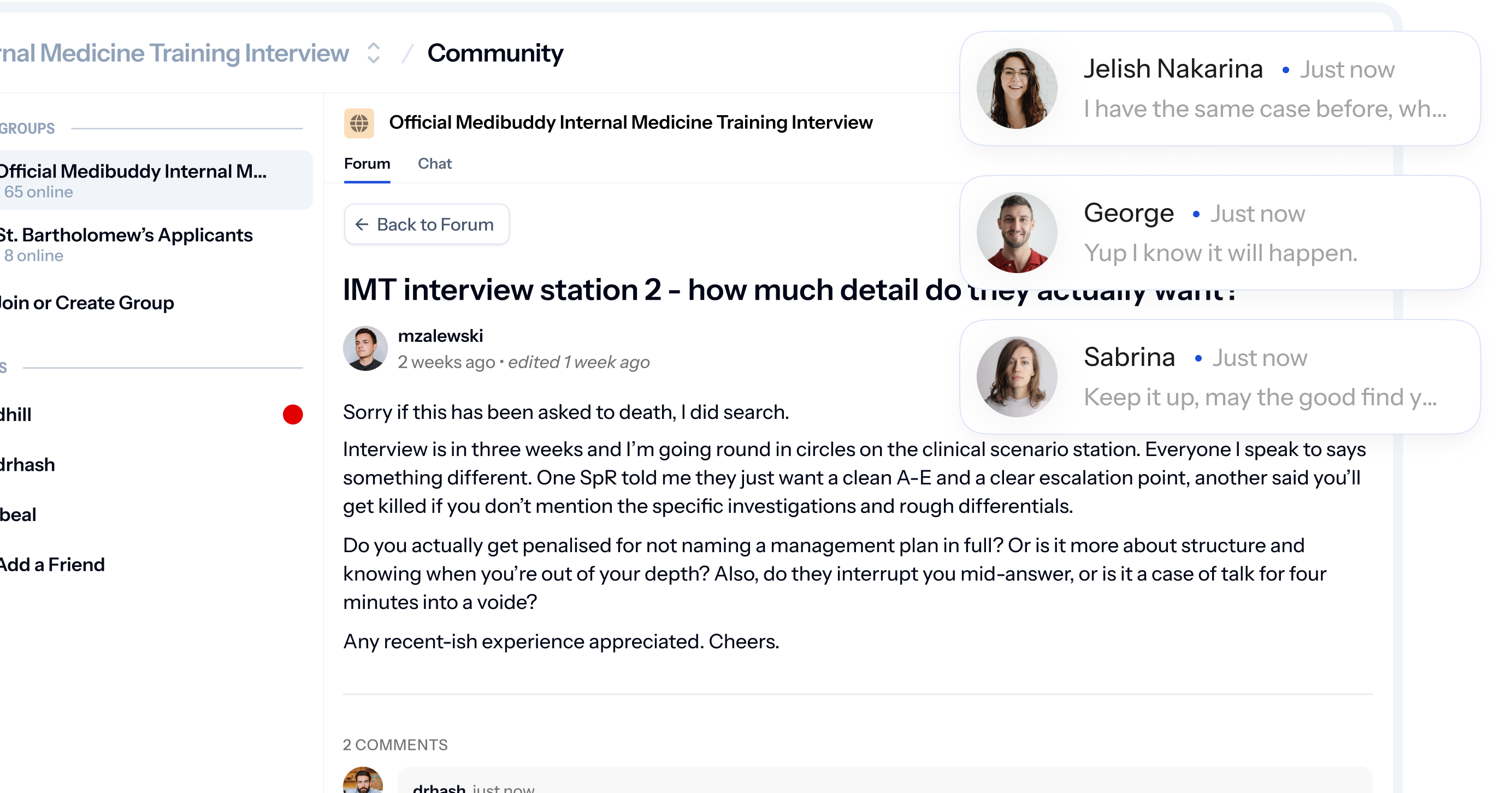

Study Groups
When you prepare in isolation, you're relying on your own interpretation of the interview process, which is one of the quickest ways to get found out on the day. Study Groups connect you with other doctors across the country who are also applying to Respiratory Medicine and GIM HST, so you can engage and network with people preparing for the same interview as you. Everyone brings different experience from different units, meaning you won't miss out on the key bits of information that could swing the interview in your favour.
Live MocksBeta
Candidates who don't take part in mocks often struggle to adapt to the pressure of the interview. Your knowledge might be correct, but without convincing delivery the interviewers will score you poorly. The best way to improve your delivery is to take part in as many live mocks as possible, which is why we haven't put a cap on how many you can do. All you have to do is join the waiting room and we'll match you with a different Respiratory Medicine and GIM HST candidate each time. Take turns as both the interviewer and candidate on real Question Bank scenarios, so you can see exactly how other candidates perform in real time while refining your own technique.
Peer FeedbackBeta
Preparing alone means you won't know how you're coming across during the interview, and preparing with the same few candidates means you'll miss opportunities to improve, which is why it's so important to get as many opinions as possible on your performance. With Medibuddy, you can record a mock and submit it for feedback from other candidates on the platform, so you receive a wider range of feedback and refine your answers with each person you practise with. Reviewing other people's mocks is just as valuable, as it shows you how strong candidates handle the same scenarios.
The interview

What to expect from the Respiratory Medicine and GIM HST interview

Higher Specialist Training in Respiratory Medicine and GIM is a dual programme run by the Royal College of Physicians of Ireland, and strong applicants are often separated by narrow margins at interview.

The interview is scored across five categories: your CV, career progression, professionalism and interview performance, your knowledge and experience of the specialty, research, audit, teaching and management, and a general internal medicine clinical scenario.

Category

CV

Your training, achievements and career narrative, and how you present them clearly and link them to what the panel is looking for.
Category

Career Progression, Professionalism and Interview Performance

Your professionalism, career planning and interview technique, shown through composure and sound judgement under pressure.
Category

Knowledge and Experience of the Specialty

The breadth of respiratory medicine, and your ability to discuss it with confidence and depth.
Category

Research, Audit, Teaching and Management

Your research, audit, teaching and management experience, and how you evidence your contribution and its impact.
Category

General Internal Medicine

Acute GIM judgement, where you assess, resuscitate and manage safely as the registrar.

How the interview is scored

Each category is marked against the Royal College of Physicians of Ireland Respiratory Medicine and GIM HST selection criteria. Our model answers are structured against those criteria, so you know exactly what a strong, well-organised answer looks like in each category.
Get ready

How to prepare for the Respiratory Medicine and GIM HST interview

Start with the Question Bank

Work through 72 scenarios across all five categories, each with a worked answer from a candidate who scored well in the 2026 interview. Start by reading how a strong answer is formed, then think about how you'd deliver it.

Talk the hard ones through in Study Groups

Study Groups are your biggest opportunity to network and connect with other candidates sitting the same interview as you. Everyone on the platform is in the same boat, so don't be scared to get involved and ask questions. Someone in your study group might just help you work through a scenario you've been struggling with.

Rehearse out loud in Live Mocks

Live mocks are where you begin to put everything you've learned into practice, and we know from experience that those who practise with a wide range of candidates usually do the best. Organise mocks with people from one of your study groups, or get matched with a random Respiratory Medicine and GIM HST candidate, then take turns as interviewer and candidate using real scenarios until answering out loud under pressure feels normal.

Get reviewed with Peer Feedback before the day

Once you've recorded a mock, you can have other community members review it. This lets you see how you come across to other people, and gives you time to refine your delivery as you revise, rather than being caught out on the day. Reviewing other people's mocks is just as crucial, as you see how other candidates navigate the same scenarios.
Questions

Frequently asked questions

What does the Respiratory Medicine and GIM HST interview involve?
It is a dual programme run by the Royal College of Physicians of Ireland, scored across five categories: CV, career progression, professionalism and interview performance, knowledge and experience of the specialty, research, audit, teaching and management, and a general internal medicine clinical scenario.
How competitive is the Respiratory Medicine and GIM HST interview?
Respiratory Medicine and GIM is a competitive dual HST pathway, and strong candidates are frequently separated by small margins at interview, which is why a structured, well-rehearsed approach matters.
Who writes the model answers?
High-scoring candidates who sat the Respiratory Medicine and GIM HST interview in 2026, so the answers reflect what came up and what scored this year.
Can I practise with other candidates?
Yes. Every Revision Platform purchase gives you the opportunity to connect with other candidates through Study Groups, Live Mocks and Peer Feedback.
How do the Live Mocks work?
All you have to do is join the waiting room, and we match you with another Respiratory Medicine and GIM HST candidate. You then take turns as interviewer and candidate on real Question Bank scenarios, so you gain experience answering out loud to a real person before you ever sit in front of the panel.
What are Study Groups and how do they help?
Study Groups are community forums for doctors across the country preparing for the same Respiratory Medicine and GIM HST interview. You can ask questions, share what you're struggling with, and compare how you'd approach a scenario.
Can I get feedback on my interview performance?
Yes. After you've recorded a mock, you can ask other members to review it, so you can see which part of your answer needs fine-tuning.
How do you keep the Respiratory Medicine and GIM HST Question Bank up to date?
We review and update it twice a year: in April after that year's interviews, and again in the autumn when the new recruitment guidance is published, so you always practise with the current five-category format.
How long do I get access for?
Access runs for 12 months from the purchase date.

Start preparing for the Respiratory Medicine and GIM HST interview

The Revision Platform gives you 72 scenarios to practise and refine with other candidates through Study Groups, Live Mocks and Peer Feedback. Ten years preparing doctors for interviews, with the questions, this year's model answers and live practice, all in one place.

Respiratory Medicine and GIM HST Revision Platform • €170

Buy Now